

Tinubu: Nigeria’s energy holds key to Africa’s prosperity as Sanwo-Olu highlights Lagos’ fuel-saving reforms
Lagos governor says CNG buses, rail expansion helping reduce transport fuel demand
President Bola Tinubu has described Nigeria’s energy resources and growing domestic refining capacity as critical to Africa’s economic prosperity, calling for stronger regional cooperation to develop an integrated energy hub.
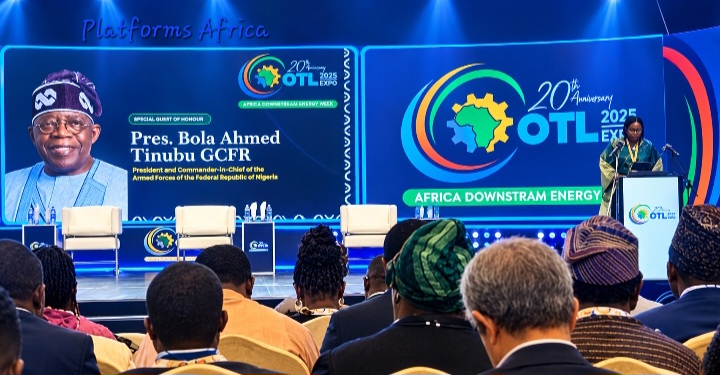
Tinubu made the declaration in a speech delivered on his behalf by the Permanent Secretary, Ministry of Petroleum Resources, Mrs Patience Oyekunle, at the 20th anniversary of OTL Africa Downstream Energy Week in Lagos on Monday.
The event, held at the Lagos Oriental Hotel, Victoria Island, had the theme, “Secure Energy, Shared Prosperity.”
“Nigeria’s energy is Africa’s opportunity. We have the market, the resources and our ambition is to support regional energy hub and other energy solutions.
“Let us look forward, not backward. That is my message for African countries represented here today,” the President said.
Tinubu assured investors and regional partners of his administration’s commitment to building an investment-driven and environmentally responsible energy sector capable of supporting economic growth in Nigeria and across the continent.
In his opening remarks, Lagos State Governor Babajide Sanwo-Olu said energy security was fundamental to economic stability, noting that high energy costs and unreliable supply affected transportation, manufacturing, food distribution and small businesses.
“When energy becomes expensive or unreliable, the damage reaches far beyond the filling station. Transport fares rise. Factories spend more to produce. Food costs more to reach the market. Small businesses lose their margins first,” he said.
Sanwo-Olu said the conference theme challenged industry stakeholders to ensure that the benefits of improved energy supply reached commuters, traders, manufacturers and other consumers.
He congratulated OTL Africa on its 20th anniversary, describing the platform as an important forum for regulators, investors, operators and policymakers to address challenges facing Africa’s downstream petroleum industry.
The governor also highlighted changes in Nigeria’s petroleum supply landscape following the removal of fuel subsidy and the opening of the market to greater private-sector participation under Tinubu’s administration.
He cited regulatory data indicating that the Dangote Refinery in Ibeju-Lekki produced about 42 million litres of petrol daily in August, while petrol imports declined by 26 per cent to approximately 14.6 million litres per day during the month.
According to him, the figures demonstrate a significant shift for a country that previously relied heavily on imported petrol.
However, Sanwo-Olu stressed that increased domestic production alone would not guarantee energy security, adding that the ultimate test was whether products were consistently available and affordable to consumers.
Lagos’ strategy to reduce transport fuel demand
The governor outlined measures being implemented by his administration to reduce transport-related fuel demand, promote cleaner energy and improve electricity supply.
On mass transportation, he said the Lagos Blue Line rail service had carried more than six million passengers since commencing operations in 2023, while the Red Line was operating between Agbado and Oyingbo.
He said the second phase of the Blue Line, extending to Okokomaiko, was scheduled for the first quarter of 2027, while the proposed Green Line would connect Lekki to Marina.
Sanwo-Olu said the expansion of rail services was part of efforts to provide alternatives to road transportation and reduce dependence on petrol-powered vehicles.
On cleaner mobility, he disclosed that, since the beginning of 2026, new buses entering the regulated public transport system had been required to operate on compressed natural gas (CNG) or electricity.
He added that 152 First and Last Mile buses had been converted to CNG, reducing their fuel costs by nearly half, while 2,000 CNG-powered trucks had been introduced under haulage reforms.
The governor said the initiatives were designed to lower operating costs, improve transport efficiency and support the transition to cleaner energy sources.
On electricity, Sanwo-Olu said Lagos was developing its electricity market under the Lagos State Electricity Law, with the Lagos State Electricity Regulatory Commission overseeing the market and state-issued distribution licences supporting improved service delivery and private investment.
He urged stakeholders at the conference to focus on three key priorities: expanding storage and distribution infrastructure to ensure reliable supply across regions; mobilising financing for downstream petroleum and gas infrastructure to reduce costs; and ensuring that the benefits of domestic refining translated into stable and affordable prices for consumers.
Sanwo-Olu said collaboration among government, regulators, investors and industry operators remained essential to achieving energy security and shared prosperity across Nigeria and Africa.
