

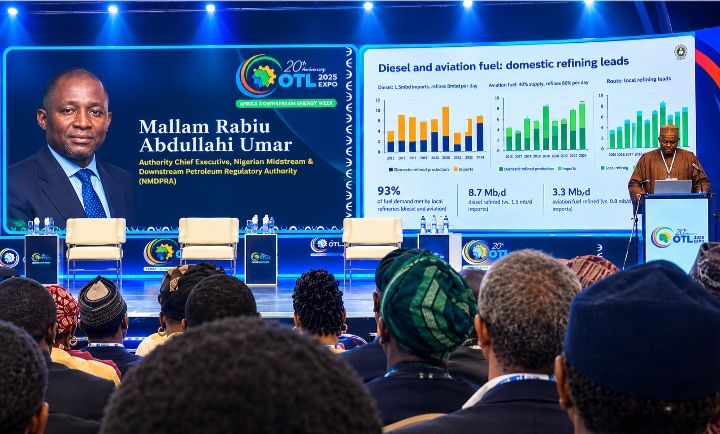
Nigeria still lacks reliable fuel consumption data 66 years after independence — NMDPRA
Umar says locally refined products now account for three in every four litres consumed; gives reasons for fresh import licences
Nigeria still lacks reliable data on its daily fuel consumption, 66 years after independence, the Authority Chief Executive of the Nigerian Midstream and Downstream Petroleum Regulatory Authority (NMDPRA), Engr. Rabiu Abdullahi Umar, has disclosed.
Umar made the disclosure at the 20th anniversary edition of the OTL 2026 Expo, held in Lagos as part of Africa Downstream Energy Week, where he outlined ongoing reforms to improve transparency, supply security and regulatory efficiency in the downstream petroleum sector.
“No consumption data yet. We are working on this because up till now no data to show that this fuel station supplied this volume, that supplied that volume. We are working with an IT firm to ensure that we have reliable consumption data,” he said.
The absence of reliable consumption figures raises concerns about effective fuel supply planning, demand forecasting and the accuracy of estimates used in monitoring petroleum distribution and possible smuggling.
Despite the data gap, Umar said locally refined petroleum products now account for three out of every four litres of fuel consumed in Nigeria, describing the development as a major shift from the country’s longstanding dependence on imported products.
However, he acknowledged that supply challenges persist, revealing that petrol consumption exceeded supply in September, with existing stocks making up the shortfall.
“Consumption ran out of supply in September — 38.7 vs. 44.4 million litres per day petrol supply vs. consumed; gap met from stocks,” he said.
To strengthen supply security, Umar said the Authority was pursuing a short-term target of maintaining between 30 and 45 days of petroleum product stock sufficiency across the country.
On the issuance of fresh import licences to petroleum marketers, the NMDPRA chief executive indicated that regulatory decisions would continue to reflect prevailing supply and demand conditions, despite increased domestic refining capacity.
He also disclosed that the Authority had signed a Memorandum of Understanding with the Federal Competition and Consumer Protection Commission (FCCPC) as part of efforts to promote transparency and fair competition in the downstream sector.
“We are doing a review of all internal licences issued by the NMDPRA. This is to surge transparency,” he said, adding that the review was aimed at sanitising the licensing process and curbing sharp practices.
On petroleum product quality assurance, Umar said seven new laboratories had been launched in Port Harcourt to test products, with two additional facilities expected to be commissioned before the end of the year.
“Before the end of the year, we are going to launch two more so that by year-end we will have nine laboratories,” he said.
He added that the Authority had also launched the second revision of the Gas Transportation Network Code, which provides a framework for the transportation of gas through the country’s pipeline infrastructure.
Umar said the NMDPRA remained committed to ensuring secure petroleum product supply, stable and fair prices, improved regulatory transparency and shared prosperity for Nigerians.
He stressed the importance of strengthening data collection and regulatory oversight to support effective planning and sustainable growth in the country’s midstream and downstream petroleum sectors.
