

Minister reset: Why Nigeria’s electricity sector is beginning to change
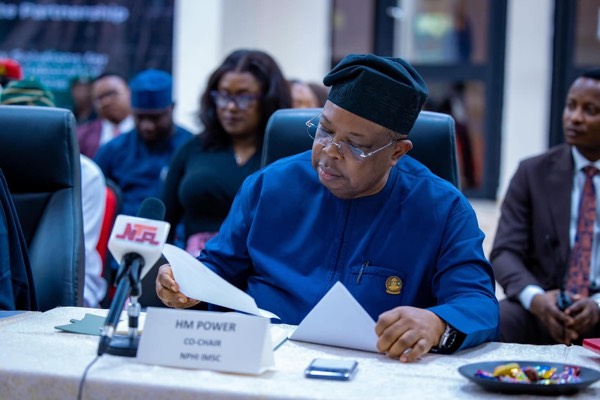
Minister of Power, reviewing critical framework documents focused on sector-wide reform and institutional accountability
An assessment of the Minister’s early interventions, reform agenda and the emerging signs of a more disciplined Nigerian electricity sector
For decades, electricity has been one of Nigeria’s most frustrating national conversations.
Governments have promised reforms. Ministers have announced roadmaps. Billions of naira have been committed to generation, transmission and distribution. Yet for the average Nigerian, the real measure of the electricity sector has never been the number of policy documents produced in Abuja. It has always been much simpler: Is there light?
That is why the emergence of Chief Joseph Olasunkanmi Tegbe, FCA, FCTI, as Nigeria’s Minister of Power deserves a closer examination.
Tegbe assumed office in June 2026 at a time when the power sector was carrying the accumulated weight of decades of structural weaknesses: inadequate generation, gas-supply constraints, transmission limitations, distribution losses, metering gaps, liquidity problems, infrastructure vandalism and a persistent trust deficit between consumers, operators and government.
President Bola Ahmed Tinubu’s decision to appoint Tegbe was therefore not merely a change of ministerial occupant. The Presidency presented him as a fiscal and economic reform expert with more than 35 years of public- and private-sector experience, including senior leadership at KPMG Africa and previous engagements with electricity-sector institutions such as NERC and NBET.
The more interesting question, however, is not whether Tegbe has an impressive résumé.
The question is whether that résumé is translating into a different style of managing Nigeria’s most stubborn infrastructure problem.
So far, the evidence suggests that something is changing.
Not yet a revolution. Not yet a solved problem. But certainly a discernible shift in direction.
The first difference: Tegbe appears to understand that power is a system, not a single ministry
One of the most important observations made by Tegbe shortly after assuming office was that Nigeria’s power problem is not purely technical.
He identified governance, coordination and institutional fragmentation as major obstacles and insisted that the agencies operating across the electricity value chain must function as “one team with one mandate.” He subsequently brought together institutions including TCN, NERC, REA, NISO, NEMSA, NBET and other sector agencies for direct engagement.
This may sound administrative, but it is actually fundamental.
Nigeria’s electricity value chain is extraordinarily interconnected. A gas shortage affects generation. Generation affects available power. Transmission determines how much of that power can move. Distribution determines what ultimately reaches consumers. Metering affects billing. Billing affects revenue. Revenue affects the ability of operators to maintain and invest in infrastructure.
Fixing one component while ignoring the others simply moves the bottleneck.
Tegbe’s approach appears to recognise this.
His five-point priority framework is therefore instructive: improve gas supply to increase generation; strengthen grid infrastructure; impose greater accountability on distribution companies; accelerate metering; and restore financial viability across the sector.
That is a significantly more coherent diagnosis than the old national fixation on simply “generating more megawatts.”
The second difference: a more visible emphasis on execution
There is an important moment in Tegbe’s assumption-of-office engagement that deserves attention.
The Minister disclosed that a feeder outage had been reported to him and that he directed its restoration within 12 hours. According to the Ministry, the feeder was restored within the specified period, after which the President was informed of the resolution.
One repaired feeder does not constitute a national power-sector achievement.
But the management philosophy behind the incident is significant.
The Nigerian public has heard enough about intentions. What the sector needs is response time, measurable targets, responsibility and consequences.
This is where Tegbe’s proposed performance-based incentive framework becomes important. The Minister has indicated that productivity, innovation and excellence should be measurable across the sector rather than left to bureaucratic discretion.
If implemented rigorously, such an approach could change the culture of public-sector power management from activity reporting to outcome reporting.
The question should no longer be: “What did the agency do?”
It should be: “What changed because the agency did it?”
There is a reason Nigerians are beginning to notice the difference
Across different parts of Nigeria, consumers have reported periods of better electricity availability than they experienced during some of the worst phases of the recent power crisis.
That observation should neither be dismissed nor exaggerated.
It is too early to credit every improvement in supply directly to Tegbe. He became Minister of Power only in June, while many of the generation, transmission and financial interventions now producing results were initiated before his appointment.
Indeed, NERC’s First Quarter 2026 data, which largely predates Tegbe’s tenure, painted a difficult picture: average available generation capacity fell to 4,457.96MW, down 17.45 per cent from the previous quarter, while total generation fell to 8,883.47GWh. Distribution losses also remained extremely high, with aggregate technical, commercial and collection losses reaching 37.44 per cent.
This is precisely why a serious assessment of Tegbe should avoid propaganda.
The Minister should not be credited for every positive development that occurred before he arrived.
But he can reasonably be assessed on what he has done with the system he inherited.
And here the picture becomes more encouraging.
Within weeks of assuming office, Tegbe moved aggressively around the issues of metering, accountability, decentralisation, renewable energy, health-sector electrification and institutional coordination.
That is where the emerging difference lies.
Metering: attacking one of the oldest sources of distrust
On July 22, the Federal Government launched the Power Force Programme under the Presidential Metering Initiative, designed to accelerate the closure of Nigeria’s metering gap while creating employment opportunities for young Nigerians.
This is more important than it may initially appear.
The meter is not just a piece of electrical equipment.
It is an instrument of commercial trust.
A consumer who receives an estimated bill without a meter is being asked to pay for electricity without an independently verifiable measurement of consumption. That creates disputes, encourages distrust and complicates revenue collection.
Tegbe’s decision to place metering prominently among his priorities therefore connects consumer protection with the financial sustainability of the electricity market.
NERC’s 2025 fourth-quarter report recorded 323,864 new meter installations during that quarter alone, but the continuing metering gap demonstrates why deployment must become faster, more transparent and more sustainable.
The challenge now is to ensure that the Power Force initiative does not become another announcement-heavy programme.
Its success must ultimately be measured by the number of customers properly metered, the reduction in estimated billing disputes and improvements in collection efficiency.
Accountability is moving closer to the centre of the power conversation
Another noteworthy development was Tegbe’s engagement with the Independent Corrupt Practices and Other Related Offences Commission on accountability within the power sector. The Ministry announced the collaboration in July as part of efforts to address corruption-related issues.
This is strategically important.
Nigeria’s electricity problem is not caused only by insufficient infrastructure. It is also affected by commercial leakages, weak enforcement, poor payment discipline, vandalism, illegal connections and institutional inefficiencies.
The Minister’s emphasis on accountability therefore goes beyond fighting corruption for its own sake. It is about protecting the economics of the electricity value chain.
A power sector that generates electricity but loses its revenue cannot sustain investment.
A distribution company that cannot collect efficiently cannot maintain infrastructure.
A government that continually fills commercial gaps without fixing the structural causes eventually runs out of fiscal space.
Tegbe’s emphasis on financial viability is therefore one of the most consequential parts of his agenda.
From centralised electricity to a more diversified energy architecture
Perhaps one of the most forward-looking aspects of the current power agenda is the growing acceptance that Nigeria’s electricity future cannot depend exclusively on the national grid.
The Electricity Act 2023 opened the door to greater participation by states and subnational electricity markets. Tegbe has moved to address the legal and institutional complexities surrounding this transition.
In July, he convened a stakeholder workshop involving federal and state institutions, legislators, regulators and other electricity-market actors. One outcome was the establishment of a nine-member inter-agency committee to support the implementation of electricity-market decentralisation. NERC confirmed the development.
This is potentially transformative.
Nigeria is too large and economically diverse to expect one central electricity architecture to efficiently serve every industrial cluster, rural community, commercial centre and emerging urban settlement.
State electricity markets, embedded generation, mini-grids, captive power and renewable-energy systems can complement the national grid.
The objective should not be “grid versus off-grid.”
It should be “reliable electricity from whatever technically and economically appropriate source works.”
The 200MW solar project: perhaps the clearest expression of the new thinking
On June 26, barely weeks into his tenure, Tegbe was at the centre of the groundbreaking of what the Federal Ministry of Power described as Sub-Saharan Africa’s largest off-grid solar project, designed to power an industrial development in Niger State, including Abuja Steel Mills.
The significance of the project goes beyond the headline figure.
A 200MW solar installation designed around industrial demand demonstrates a different way of thinking about electricity.
Instead of waiting indefinitely for the national grid to become capable of satisfying every industrial requirement, large consumers can increasingly develop dedicated, embedded and renewable power solutions.
That model has enormous potential in Nigeria.
Manufacturing clusters, universities, hospitals, agricultural processing zones, technology parks and major commercial developments can all become candidates for distributed generation.
It is also consistent with the broader investment direction of the Ministry, which has identified renewable energy as one of the priorities for the sector.
Power for health: when electricity becomes a matter of life and death
Another significant intervention is the Nigeria Power for Health Initiative.
The initiative seeks to develop sustainable electricity solutions for healthcare facilities using public-private partnerships and an Energy-as-a-Service model. The Federal Ministry of Health says the framework is designed to attract private investment, development finance and other forms of capital into healthcare electrification.
This is precisely the kind of policy intersection Nigeria needs.
Electricity is not simply an economic commodity.
In a hospital, electricity can mean the difference between an operational ventilator and a non-functional one; between a functioning theatre and a cancelled procedure; between preserved vaccines and spoiled vaccines.
The NPHI therefore demonstrates an important shift from thinking about electricity purely in terms of megawatts to thinking about what those megawatts enable.
Rural electrification is also receiving renewed institutional attention
On August 7, Tegbe inaugurated the newly constituted Governing Board of the Rural Electrification Agency and charged its members to make decisions based on how projects improve the lives and livelihoods of ordinary Nigerians.
This is particularly relevant because Nigeria’s energy-access challenge is not uniform.
A family in Lagos, an agro-processor in Ibarapa, a health centre in a remote community and a steel plant in Niger State do not necessarily require the same electricity solution.
REA’s mandate is specifically focused on unserved and underserved communities, using programmes including mini-grids, solar systems and productive-use energy interventions.
The agency’s commissioning of a 505kWp interconnected solar mini-grid in Epe, Lagos State, in June 2026 illustrates how distributed renewable energy can deliver power directly to communities, households, businesses and public institutions.
The opportunity now is to move from isolated projects to scalable models.
The media roundtable: an important signal of openness
The July 31 National Media Roundtable themed “Resetting the Sector” may ultimately prove to be one of Tegbe’s most consequential communications initiatives.
It brought the media directly into the conversation about the sector’s reform agenda and gave the Minister an opportunity to explain the rationale behind the reset.
Minister of Power, Chief Joseph Olasunkanmi Tegbe, leading strategic stakeholder engagements to ensure electricity agencies function with “one team, one mandate.”
The message was clear: make electricity more available, make the grid more reliable, make the market financially sustainable and restore investor confidence.
That engagement matters because power-sector reform cannot succeed in a communication vacuum.
The media should not merely be used to announce commissioning ceremonies.
It should have access to performance data, milestones, failures, explanations and timelines.
If Tegbe’s ministry can institutionalise a culture in which Nigerians are periodically shown what was promised, what was achieved, what was delayed and why, it will do something almost as valuable as adding megawatts: it will begin rebuilding public trust.
But the Minister must still be judged by the hard numbers
This is where optimism must meet discipline.
Nigeria does not need another “miracle minister.”
It needs an institution that works.
The structural problems remain formidable. NERC’s Q1 2026 figures showed a sector operating under severe pressure before Tegbe took office: generation and available capacity were down, distribution losses were high, and customer complaints were rising.
The sector also continues to face liquidity challenges.
The Federal Government’s broader Power Sector Debt Reduction Programme has been designed to address verified obligations in the generation and gas-to-power chain, including a first ₦501 billion bond that was reported as oversubscribed, alongside further planned financing.
Tegbe therefore has no luxury of pretending that policy announcements alone will fix the system.
The real test will be whether generation becomes more predictable; whether transmission constraints decline; whether grid disturbances become less frequent and less severe; whether metering accelerates; whether DisCos reduce technical and commercial losses; whether investors regain confidence; whether sector debts become manageable; and, above all, whether ordinary Nigerians receive more reliable electricity.
Tegbe’s greatest asset may be his background
There is something particularly relevant about Tegbe’s professional background.
He is not entering the Ministry principally as a career politician.
The Presidency described him as a fiscal and economic reform specialist with more than three decades of experience, while his professional profile includes institutional transformation, strategy, governance, technology advisory and public-sector reform.
That matters because Nigeria’s power crisis is simultaneously an engineering problem, a financial problem, a governance problem, a regulatory problem and an investment problem.
An engineer may understand the machine.
An accountant may understand the books.
A regulator may understand the rules.
An investor may understand the market.
But the Minister of Power has to understand how all four interact.
Tegbe’s professional history gives him an unusually broad platform from which to approach that problem.
Whether he can convert that advantage into durable institutional reform remains the central question.
The real test is sustainability
There is a temptation in Nigeria to celebrate every improvement in electricity supply as if the crisis has been solved.
We should resist that temptation.
A few weeks of better supply are welcome, but they are not structural reform.
The real victory will come when Nigerians stop treating electricity as an unpredictable event.
When a manufacturer can plan production without budgeting primarily for diesel.
When a student can study without wondering when the next outage will occur.
When a hospital can perform critical procedures without starting a generator before switching on its medical equipment.
When a small business can calculate its operating costs without treating petrol and diesel as unavoidable electricity tariffs.
When investors can assess Nigeria’s electricity market and see predictable rules, reliable infrastructure and commercially sustainable returns.
That is the standard by which Joseph Tegbe should ultimately be judged.
Barely two months into his tenure, it would be intellectually dishonest to declare Joseph Tegbe the man who has solved Nigeria’s electricity crisis.
He has not.
No minister could realistically accomplish that in a matter of weeks.
But it would be equally unfair to dismiss the emerging evidence of a more deliberate and coordinated approach.
From the five-point reform agenda to direct engagement with sector agencies; from metering and accountability to electricity-market decentralisation; from healthcare electrification to rural renewable energy; from industrial-scale solar to the July media roundtable and the latest REA board inauguration, Tegbe’s early tenure has been characterised by a noticeable emphasis on coordination, execution, investment and institutional discipline.
And perhaps that is the most important development.
Nigeria does not need another minister who simply promises that light will come.
It needs a minister who understands why the light goes off, identifies who is responsible, fixes the system behind the switch and builds structures capable of keeping the light on after the minister has left office.
That is the real meaning of a power-sector reset.
For now, Nigerians are watching.
And, increasingly, they are beginning to notice.
If that emerging improvement can be converted into measurable, sustained and nationwide reliability, Joseph Olasunkanmi Tegbe may eventually be remembered not merely as another occupant of the Power Ministry, but as the minister who helped move Nigeria’s electricity conversation from emergency management to institutional transformation.
The lights are not yet permanently on.
But for a country that has spent decades learning to live in the dark, even the emergence of a more credible path toward stability is worth taking seriously.
