

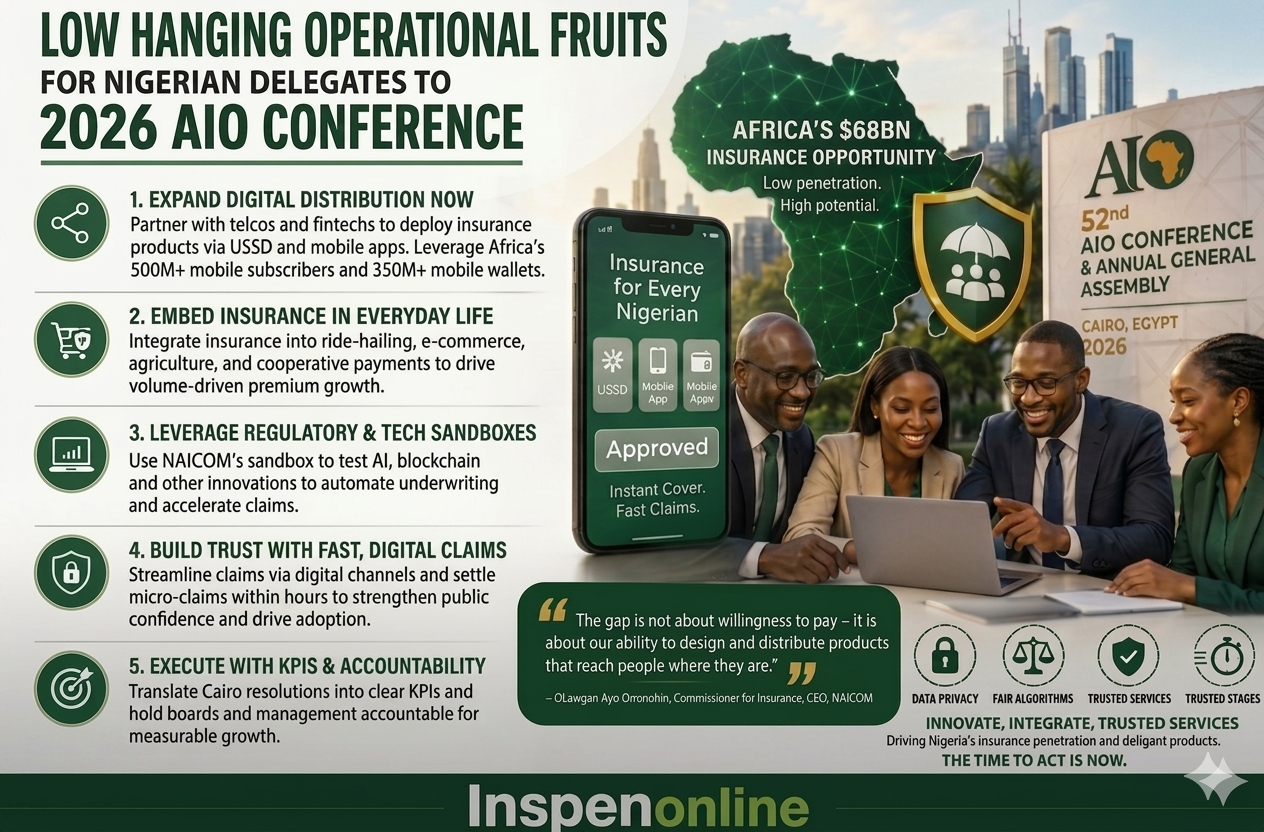
Low hanging operational fruits for Nigerian delegates to 2026 AIO conference
Following resolutions at the just-concluded 52nd African Insurance Organisation (AIO) Conference and Annual General Assembly in Cairo, Egypt, Nigerian insurance operators must immediately domesticate key takeaways by embedding quick-win operational strategies to expand market share.
The call comes on the heels of declarations by the Commissioner for Insurance and Chief Executive Officer of the National Insurance Commission (NAICOM), Olusegun Ayo Omosehin, who stated at the conference that Africa’s low insurance penetration represents a multi-billion-dollar opportunity rather than a limitation, given the continent’s existing $68 billion premium pool.
With the regulatory tailwinds provided by the Nigerian Insurance Industry Reform Act (NIIRA) 2025, industry experts note that local underwriting companies no longer have excuses for stagnant growth.
The focus must now shift from high-level conference rhetoric to strategic, immediate operational execution.
A major consensus from the AIO panel was that distribution failure, rather than a lack of public interest, remains the primary driver of low insurance penetration. Traditional agent-based networks continue to miss over 90 per cent of the addressable population, particularly in the informal and rural sectors.
To bridge this gap, Nigerian operators must immediately plug into the continent’s expanding digital ecosystem, which currently boasts over 500 million mobile subscribers and 350 million mobile wallets.
By partnering with telecommunication firms and fintech platforms, insurers can deploy retail products via Unstructured Supplementary Service Data (USSD) and mobile applications. This provides a ready-made, low-cost framework for premium collection and micro-claims payouts without heavy capital expenditure.
Rather than marketing insurance as a standalone product—which often faces cultural and economic resistance—operators must embed insurance into everyday transactions.
Integrating insurance policies directly into ride-hailing services, e-commerce checkouts, agricultural input distribution and cooperative society contributions offers an immediate path to volume-driven premium growth.
With NAICOM driving the transition toward principles-based supervision and enforcing robust risk-based capital frameworks, operators are expected to look inward and optimize their risk portfolios.
Forward-thinking companies should immediately utilize NAICOM’s regulatory sandbox initiatives to test innovative tech-driven solutions, such as Artificial Intelligence (AI) and blockchain, to automate underwriting and accelerate claims management.
“The gap is not about willingness to pay—it is about our ability to design and distribute products that reach people where they are,” Omosehin said.
While deploying AI and data analytics serves as a quick win for internal efficiency, the AIO resolutions also cautioned against emerging operational risks, including data privacy infractions, algorithmic bias, and escalating cybersecurity threats.
Nigerian insurance institutions must match their digital expansion with robust cyber-defence frameworks and transparent claims procedures.
Streamlining the claims process via digital channels so that micro-claims are settled within hours will build the public trust necessary to scale market adoption.
As the continental industry targets a 3 to 5 per cent insurance penetration rate within the next five to seven years, the immediate challenge lies with Nigerian boards and executive management teams to swiftly translate these Cairo resolutions into actionable corporate key performance indicators (KPIs).
