

Imported petrol undercuts Dangote Refinery price by ₦135.76/L as supply gaps persist
In a striking twist for Nigeria’s evolving energy market, newly released industry data shows that imported petrol is now significantly cheaper than locally refined fuel from the Dangote Petroleum Refinery, underscoring persistent structural gaps in domestic supply.
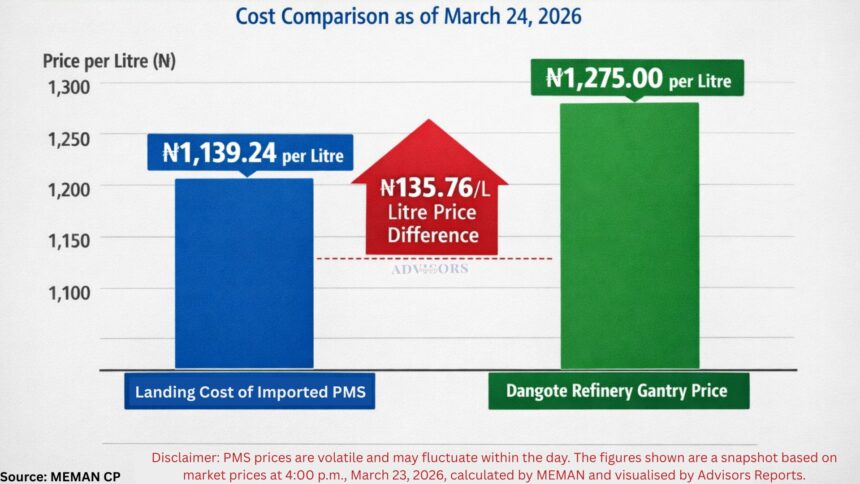
Figures published by the Major Energies Marketers Association of Nigeria (MEMAN) as of March 24, 2026, reveal that the landing cost of imported Premium Motor Spirit (PMS) stands at ₦1,139.24 per litre—undercutting the refinery’s gantry price of ₦1,275 per litre by ₦135.76.
The data, benchmarked against both ASPM and NPSC-NOJ pricing indices, signals a rare pricing advantage for importers in a market long expected to tilt in favour of domestic refining.
Instead, current conditions have flipped that expectation, with imports emerging as the more competitive option.
This development comes at a time when Nigeria’s fuel demand continues to outpace local production. According to the Nigerian Midstream and Downstream Petroleum Regulatory Authority (NMDPRA), the Dangote refinery supplied an average of 36.6 million litres per day in February—well below the nation’s estimated daily consumption of 56.9 million litres.
The resulting deficit has forced marketers to lean heavily on imports and stock drawdowns to keep pumps running across the country.
Speaking on the global stage at CERAWeek by S&P Global in Houston, the Minister of State for Petroleum Resources (Oil), Heineken Lokpobiri, acknowledged the reality: Nigeria, despite recent strides in refining capacity, still depends on imports to meet its energy needs.
Behind the scenes, regulators are moving to stabilise supply. Industry sources indicate that the NMDPRA has issued fresh import licences to six major marketers—including NIPCO Plc, Matrix Energy Group, A.A. Rano Nigeria Limited, AYM Shafa Limited, Bono Oil and Gas, and Pinnacle Oil and Gas Limited—with a combined allocation of 180,000 tonnes.
The move follows an earlier first-quarter allocation of 300,000 tonnes to MRS Oil Nigeria Plc, reflecting a deliberate strategy to plug supply gaps and maintain market stability.
Yet uncertainty lingers.
The regulator has not officially confirmed the allocation timeline, and at least one listed firm has reportedly distanced itself from the licensing claims—highlighting ongoing opacity in the system.
For market analysts, the implications are clear. Speaking during a MEMAN-hosted webinar alongside S&P Global, energy expert Joe Nwakwue stressed that continued importation is not just necessary—it is essential for competition.
Allowing imports, he argued, keeps the market “contestable,” preventing any single supplier from dominating pricing and ensuring consumers benefit from competitive pressures.
As Nigeria pushes toward energy self-sufficiency, the latest data delivers a sobering reality check: until domestic refining can consistently meet demand, imports will remain not just a fallback—but, for now, the cheaper option.
