

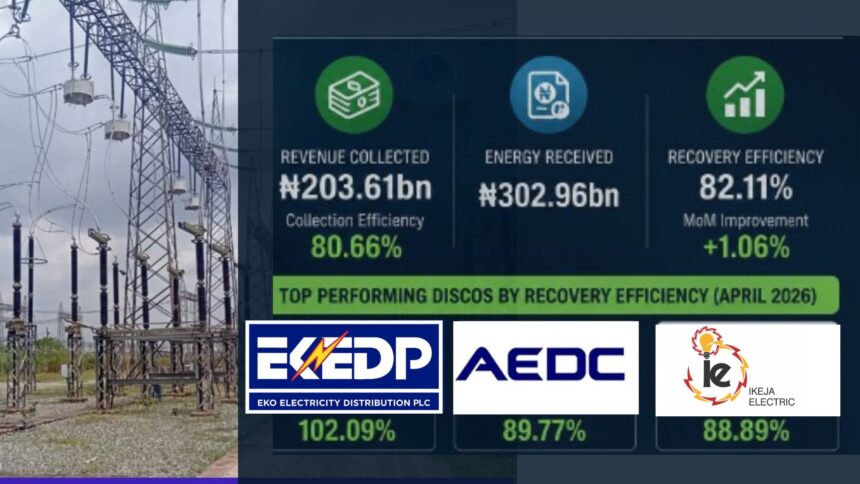
11 DisCos improve cash flow, recover ₦203.6bn from ₦302.9bn billing in April
The eleven (11) major electricity distribution companies (DisCos) in Nigeria recorded improved cash flow performance in April 2026, as total revenue collections rose to ₦203.61 billion out of ₦302.96bn energy received, achieving a collection efficiency of 80.66 per cent.
The Eko Electricity, Abuja DisCo and Ikeja Electric therefore emerged as the top three performing electricity distribution companies with 102.09 percent, 89.77% and 88.89% respectively with the highest recovery efficiency levels for April 2026, underscoring improvements in the financial health and operational efficiency of the sector.
The Nigerian Electricity Regulatory Commission (NERC) made revealed these details in its April 2026 factsheet on the commercial performance of DisCos, released on Monday and analysed by Advisors Reports, compared to the previous month.
According to the NERC, the DisCos collectively recorded a billing efficiency of 83.32% in April 2026, with total energy billed amounting to ₦252.43 billion out of ₦302.96 billion received during the period.
The report further indicated an improvement in collection performance, as collection efficiency rose to 80.66%, translating to total revenue collections of ₦203.61 billion for the month under review.
In terms of revenue recovery, the power sector posted an overall recovery efficiency of 82.11%, reflecting a positive growth of 1.06% compared to March 2026.
This data by NERC therefore signals gradual progress in the industry’s ability to convert billed energy into actual cash flow, despite ongoing operational and structural challenges.
A further analysis of performance of individual DisCo showed that Abuja DisCo’s performance, which recorded ₦51.13 billion in energy received and ₦44.36 billion billed, translating to a billing efficiency of 86.77% (a decline of 0.74% month-on-month).
Benin DisCo received ₦23.12 billion and billed ₦17.10 billion, achieving a billing efficiency of 73.98%, representing a 2.38% decline compared to March. Similarly, Eko DisCo recorded ₦42.72 billion in energy received and ₦39.12 billion billed, with a strong billing efficiency of 91.56%, though slightly down by 0.74%.
Enugu DisCo emerged as one of the top performers, posting ₦21.23 billion in energy received and ₦19.70 billion billed, resulting in a billing efficiency of 92.77%, an improvement of 5.56%. Ibadan DisCo also showed significant progress, with ₦34.28 billion received and ₦30.35 billion billed, achieving 88.55% efficiency, marking a notable 12.99% increase.
In contrast, Ikeja DisCo recorded ₦49.31 billion in energy received and ₦41.50 billion billed, with billing efficiency declining to 84.16%, down by 3.60%. Jos DisCo posted ₦15.90 billion received and ₦11.05 billion billed, translating to 69.50% efficiency, a 2.60% drop.
Kaduna DisCo recorded one of the sharpest declines, with ₦16.76 billion in energy received and ₦10.52 billion billed, resulting in a low billing efficiency of 62.81%, down by 11.76%. Kano DisCo reported ₦18.97 billion received and ₦16.04 billion billed, achieving 84.56% efficiency, though down by 2.55%.
Port Harcourt DisCo posted ₦21.34 billion in energy received and ₦17.32 billion billed, with billing efficiency at 81.19%, reflecting a 9.17% decline.
Yola DisCo, despite its relatively smaller scale, showed improvement with ₦7.99 billion received and ₦5.30 billion billed, achieving 66.35% efficiency, up by 7.67%.
Meanwhile, on the revenue collection and recovery performances, the Abuja DisCo recorded a revenue collection of ₦37.55 billion, translating to a collection efficiency of 84.63%.
The DisCo achieved an actual average collection of ₦112.73/kWh, out of allowed average tariff of ₦125.57/kWh.
Benin DisCo collected ₦16.34 billion out of ₦17.10 billion billed, posting a strong collection efficiency of 95.52%.
The DisCo operated with an allowed average tariff of ₦125.50/kWh and achieved an actual average collection of ₦108.75/kWh.
Eko DisCo delivered one of the strongest performances, recording ₦36.87 billion in revenue with a collection efficiency of 94.26%.
The DisCos outperformed its allowed average tariff of ₦125.80/kWh, achieving an actual average collection of ₦128.43/kWh.
Enugu DisCo recorded a revenue of ₦13.92 billion, with collection efficiency at 70.66%. Against an allowed tariff of ₦124.80/kWh, it achieved an actual average collection of ₦100.71/kWh.
Ibadan DisCo posted ₦21.74 billion in revenue, with a collection efficiency of 71.63% and an actual average collection of ₦97.71/kWh compared to an allowed ₦125.21/kWh.
Ikeja DisCo maintained a relatively strong performance, collecting ₦37.34 billion with an efficiency of 89.97%. It achieved an actual average collection of ₦108.71/kWh against an allowed tariff of ₦122.30/kWh.
Other DisCos fall in the category of the weaker performers, they include Jos DisCo which recorded ₦6.51 billion in revenue, with a collection efficiency of 58.93% and an actual average collection of ₦65.18/kWh, significantly below its allowed tariff of ₦124.20/kWh.
Kaduna DisCo also underperformed, posting ₦5.83 billion in revenue and a collection efficiency of 55.38%, with actual collections at ₦52.56/kWh against an allowed ₦121.80/kWh.
Kano DisCo emerged as the lowest performer in collection efficiency, recording ₦8 billion in revenue and an efficiency of 49.89%, with actual collections at ₦52.56/kWh compared to an allowed ₦122.40/kWh.
Port Harcourt DisCo, however, posted a strong recovery with ₦15.83 billion in collections and a high efficiency of 91.41%, achieving ₦111.90/kWh against an allowed ₦123.80/kWh.
Yola DisCo recorded ₦3.63 billion in revenue, with collection efficiency at 68.61% and an actual average collection of ₦82.64/kWh compared to an allowed ₦127.00/kWh.
The NERC factsheet of the performance of the DisCos in April showed a widening gap between top-performing and underperforming DisCos, particularly in their ability to convert billed energy into actual revenue, with tariff realization also remaining a key challenge across several franchise areas.
