

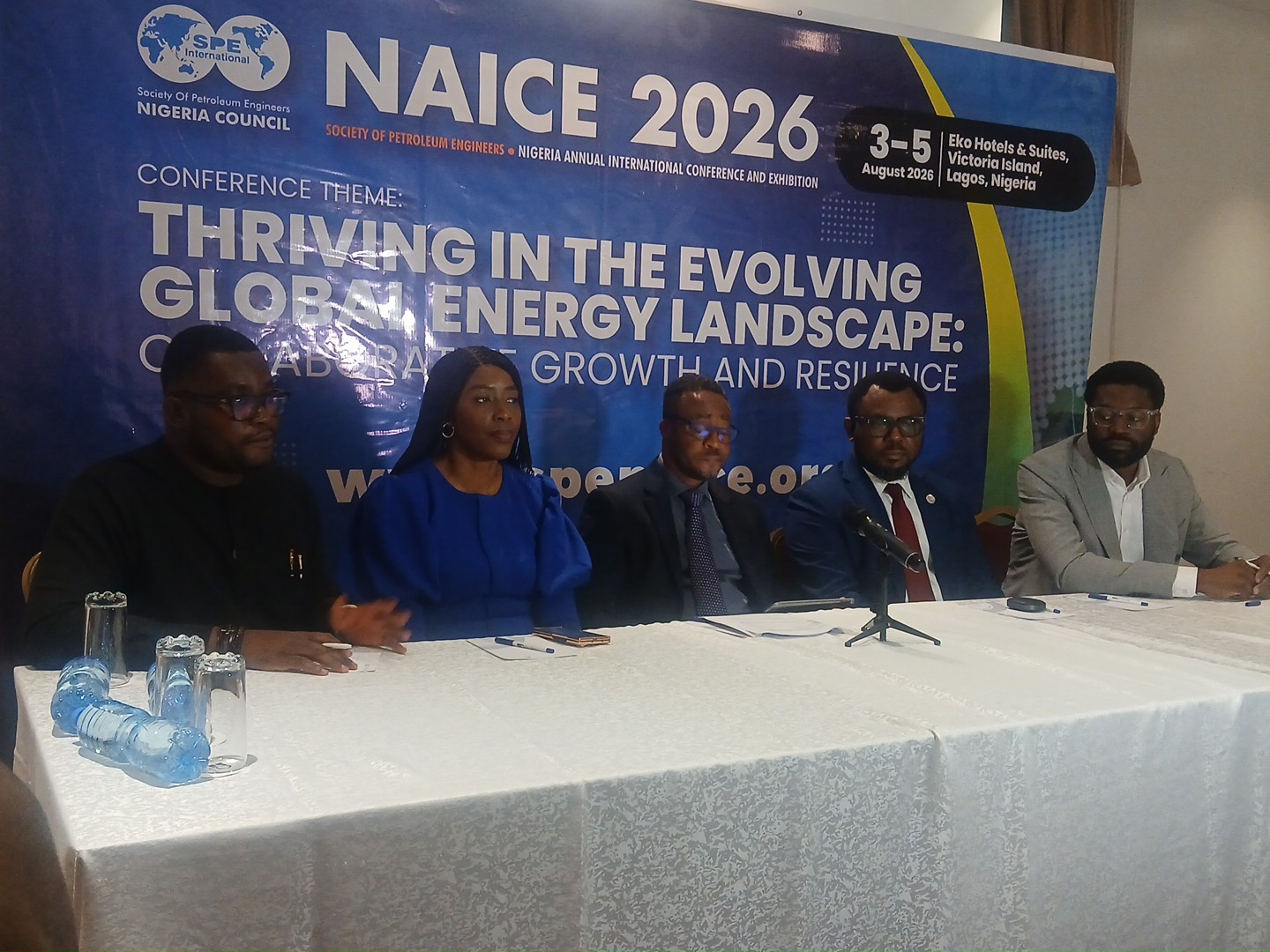
SPE commends FG’s transparent licensing round, says NAICE 2026 will drive Nigeria’s energy future
The Society of Petroleum Engineers (SPE) Nigeria Council has commended the Federal Government, the Ministry of Petroleum Resources and the Nigerian Upstream Petroleum Regulatory Commission (NUPRC) for conducting what it described as a transparent, automated and market-driven licensing process under the Petroleum Industry Act (PIA).
Chairman of the SPE Nigeria Council, Engr. Francis Nwaochei, gave the commendation during a pre-event press conference ahead of the 49th Nigeria Annual International Conference and Exhibition (NAICE 2026), scheduled to hold from August 3 to 5, 2026, at the Expo Centre, Eko Hotel and Suites, Victoria Island, Lagos.
The conference is themed: “Thriving in the Evolving Global Energy Landscape: Collaborative Growth and Resilience.”
Nwaochei said the theme reflects the realities of today’s global energy industry, where investment patterns, technological innovation, geopolitics and decarbonisation are rapidly reshaping the sector.
He said Africa must pursue energy security, industrial growth and environmental sustainability simultaneously, stressing that collaboration among governments, regulators, operators, investors, technology providers and financial institutions is critical to achieving these goals.
According to him, the recently concluded 2025 Licensing Round, in which the NUPRC awarded 37 oil and gas blocks to 31 preferred bidders, marks a significant milestone for Nigeria’s upstream sector.
He noted that while the licensing exercise was a major achievement, the real challenge is converting the newly awarded assets into commercially viable production through technology, efficient reservoir management and sustained investment.
“NAICE 2026 will provide the first major platform for stakeholders to discuss how these assets can be developed to support Nigeria’s target of producing three million barrels of oil per day by 2030,” he said.
Nwaochei also observed that the ongoing divestment of onshore assets by International Oil Companies (IOCs) has placed indigenous operators at the centre of Nigeria’s oil production, with local companies now accounting for about 60 per cent of national output.
He urged indigenous firms to strengthen their technical capacity, financial resilience and operational efficiency as they assume greater responsibility for managing the country’s oil and gas assets.
On the downstream sector, he said the expansion of private and modular refineries presents an opportunity to transform Nigeria into a regional refining hub, while stressing the need to balance the Domestic Crude Supply Obligation under the PIA with market-driven investment returns.
Speaking on Nigeria’s production targets, Nwaochei said achieving three million barrels per day will require new field developments, deepwater projects and expanded gas commercialisation. He added that increased condensate production and the expected commencement of the African Energy Bank would improve financing for energy projects across the continent.
He also emphasised the importance of protecting critical oil and gas infrastructure through advanced technologies such as digital monitoring, fibre-optic pipeline surveillance and automated metering, supported by effective implementation of the Host Community Development Trusts established under the PIA.
Highlighting the conference programme, Nwaochei said NAICE 2026 will feature technical sessions, executive panel discussions, specialised workshops, an international exhibition, leadership programmes for women, mentorship sessions for young professionals, and capacity-building initiatives for students and industry leaders.
More than 600 peer-reviewed technical papers will be presented, covering key industry issues, including artificial intelligence, deepwater operations, drilling technology, reservoir management, carbon capture and energy transition.
On energy transition, Nwaochei said Africa needs a practical and balanced approach that recognises the continued importance of oil and gas in driving industrialisation, economic growth and energy security.
He stressed that reducing carbon emissions through lower gas flaring, methane reduction and cleaner energy technologies will improve the competitiveness of Nigerian crude in the international market, while natural gas remains the country’s key transition fuel.
He added that recommendations from the conference would be compiled into an official communiqué for submission to government agencies, regulators and industry stakeholders to support evidence-based policy implementation.
Nwaochei called on investors, operators, policymakers, researchers, service companies and young professionals to participate in NAICE 2026, describing the conference as a platform where policy discussions will be translated into practical solutions for the future of Africa’s energy industry.
