

Senate divided over ₦1.3bn allocation to alleged ‘Ghost Agency
The Senate on Wednesday witnessed a sharp division among lawmakers over the controversial ₦1.3 billion allocation to the Presidential Foreign Intervention Promotion Council (PFIPC), an agency the Presidency has declared non-existent.
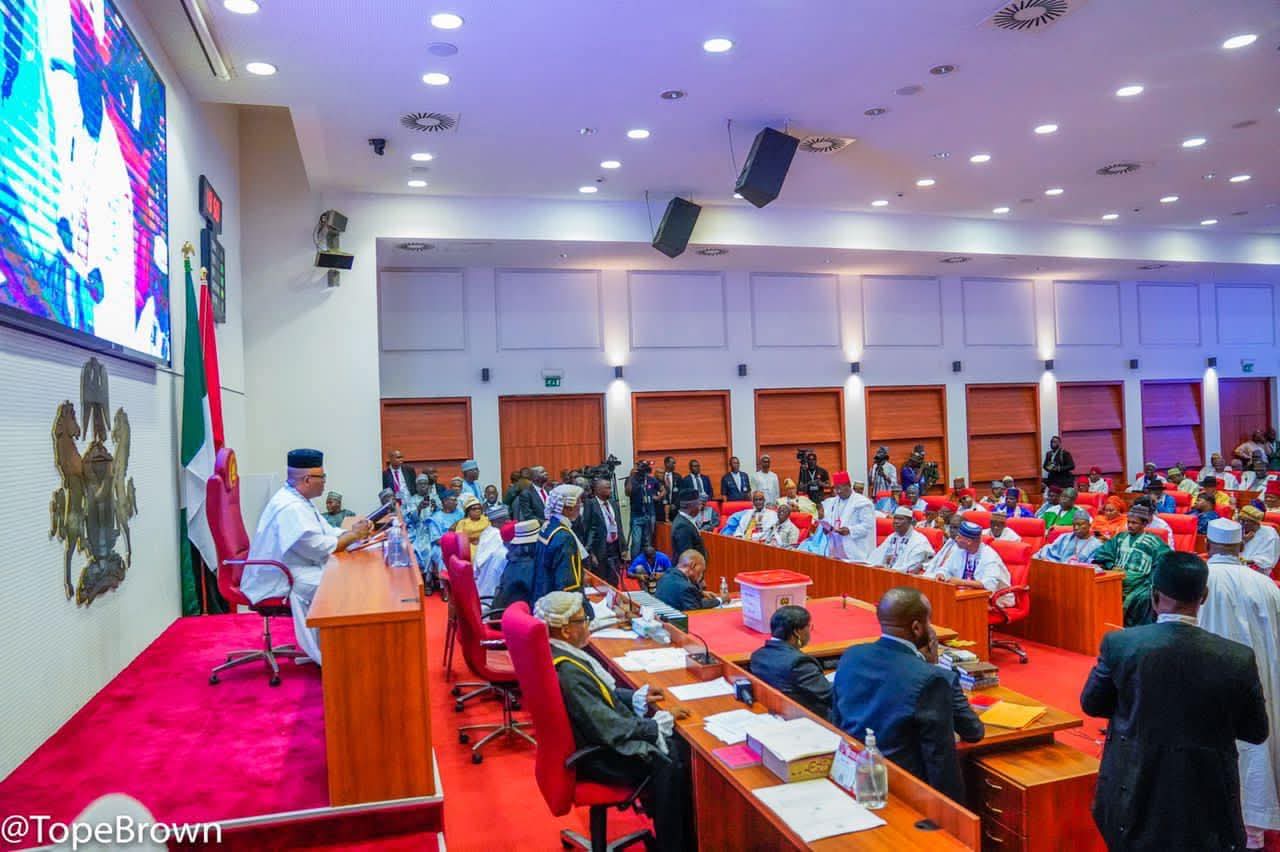
The disagreement arose during plenary when Senator Kawu Sumaila (Kano South) called for an immediate Senate investigation into how the alleged agency was captured in the 2026 Appropriation Act, while Deputy Senate President Jibrin Barau urged lawmakers to allow the ongoing investigation by the Independent Corrupt Practices and Other Related Offences Commission (ICPC) to run its course.
At the centre of the controversy is a budgetary allocation of ₦1,302,978,784 listed under budget code 0111062001 in the 2026 Appropriation Act. The provision comprises ₦1,002,978,784 for personnel costs and ₦300 million for capital expenditure, despite the Presidency’s insistence that the PFIPC was never established by the Federal Government.
Raising the matter during plenary, Sumaila described the development as a serious breach of the nation’s budgetary process, questioning how an agency now declared fictitious could have passed through both the executive and legislative stages of the appropriation process without detection.
He argued that the issue goes beyond the budgetary allocation itself and raises fundamental concerns about the integrity of Nigeria’s public finance management system.
According to him, Nigerians deserve a full explanation as to how an agency with no legal backing secured over ₦1 billion in the national budget.
He therefore urged the Senate to mandate the appropriate committee to immediately investigate the circumstances surrounding the allocation and identify those responsible for the anomaly.
“This is not just about the money. It is about protecting the credibility of our budgetary process. We owe Nigerians a thorough investigation into how this happened,” Sumaila said.
However, Deputy Senate President Barau opposed the call for an immediate parliamentary probe, noting that the Presidency had already directed the ICPC to investigate the matter.
He advised lawmakers to await the outcome of the anti-graft agency’s investigation before deciding whether further legislative intervention would be necessary.
“The Presidency has directed the ICPC to investigate the scandal surrounding the PFIPC. The Senate should allow the commission to complete its assignment before taking any further action,” Barau said.
His intervention effectively stalled moves for an immediate Senate investigation.
The controversy followed a statement issued by the Presidency on July 1, declaring the Presidential Foreign Intervention Promotion Council “a fictitious body” that was never created by the Federal Government.
The Presidency also disowned an appointment letter allegedly issued to Prince Adeniyi Adeyemi Mathew, who reportedly used the document to obtain office accommodation within the Federal Secretariat in Abuja.
Chief of Staff to the President, Femi Gbajabiamila, denied signing or authorising the appointment letter, insisting it did not originate from his office.
Following the revelation, the Presidency directed the ICPC to investigate the matter and also mandated the Department of State Services (DSS), the Nigeria Police Force and the Economic and Financial Crimes Commission (EFCC) to identify and prosecute all those involved.
Prince Adeyemi has, however, reportedly expressed his willingness to cooperate with investigators, stating that he is prepared to assist the ICPC in uncovering the facts surrounding the controversy.
The development has renewed concerns over transparency and accountability in Nigeria’s budgetary process, with stakeholders questioning how an agency alleged to have no legal existence could receive a budgetary allocation running into billions of naira.
Attention is now focused on the outcome of the ICPC investigation, which is expected to determine the next course of action in what is fast becoming one of the most controversial budget-related scandals of the year.
