

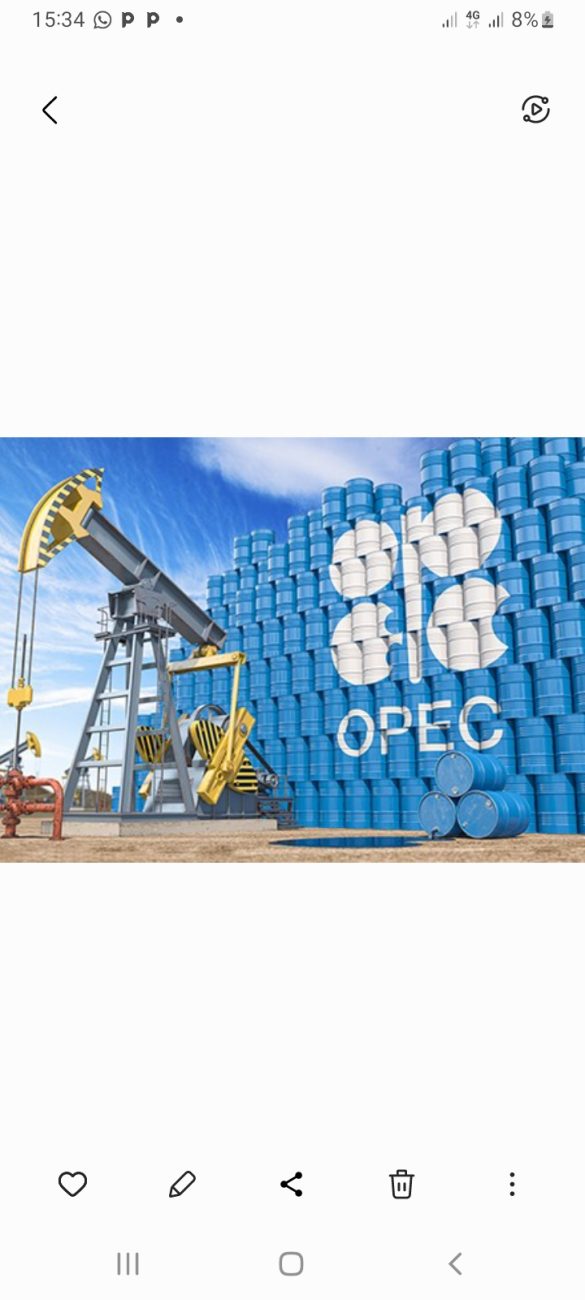
OPEC+ May approve fourth consecutive output increase
OPEC+ is expected to approve another production increase at its July 5 meeting, according to reports.
The proposed increase of about 188,000 barrels per day would match the hikes adopted for June and July.
The move comes as oil prices stabilize following the recent Middle East conflict and OPEC+ reviews future production quotas.
OPEC+ members are expected to approve another increase in oil production targets when they meet on July 5, Reuters reported on Wednesday, July 1, citing three sources familiar with the matter.
The sources said the group is likely to raise output by about 188,000 barrels per day (bpd) in August, matching the increases adopted for June and July. OPEC+ has not yet commented publicly on the proposal. If approved, it would mark the fourth consecutive increase since April.
Seven key members of the alliance—Saudi Arabia, Russia, Iraq, Kuwait, Algeria, Kazakhstan, and Oman—have already raised their combined production quotas by about 800,000 bpd between April and July.
The increases are part of the gradual rollback of a 1.65 million bpd production cut agreed in 2023, when the United Arab Emirates (UAE) was still a member of the alliance. Abu Dhabi withdrew from OPEC+ on May 1 after years of disputing production quotas it viewed as inconsistent with its investment in expanding output capacity.
Higher production targets amid a complex market
OPEC+ production fell from 42.77 million bpd in February 2026 to 33.13 million bpd in May, according to the group’s official data. The decline followed the late-February conflict involving the United States, Israel, and Iran, which led to the closure of the Strait of Hormuz—a shipping route that carries about 20% of the world’s oil supply—and disrupted exports from several OPEC+ members.
Oil prices, however, have since returned to pre-war levels. Brent crude, the international benchmark, traded at about $72 per barrel on July 1, according to Fortune, down sharply from the more than $100 per barrel reached during the conflict. A memorandum of understanding signed by Washington and Tehran has raised hopes for a gradual normalization of oil flows through the region.
Iraq, OPEC’s second-largest producer after Saudi Arabia, has also drawn attention in recent days. Reuters reported last week that Baghdad had considered leaving the group unless its production quota was raised to better reflect its actual production capacity. Iraq’s Oil Ministry denied the report, saying it “does not reflect the government’s official position,” while reaffirming its call for a review of production quotas within the existing OPEC+ framework.
At the same time, OPEC+ is conducting an independent assessment of its members’ production capacity to establish new production baselines starting in 2027. The review, carried out by a U.S. consulting firm, is expected to be completed in September.
