

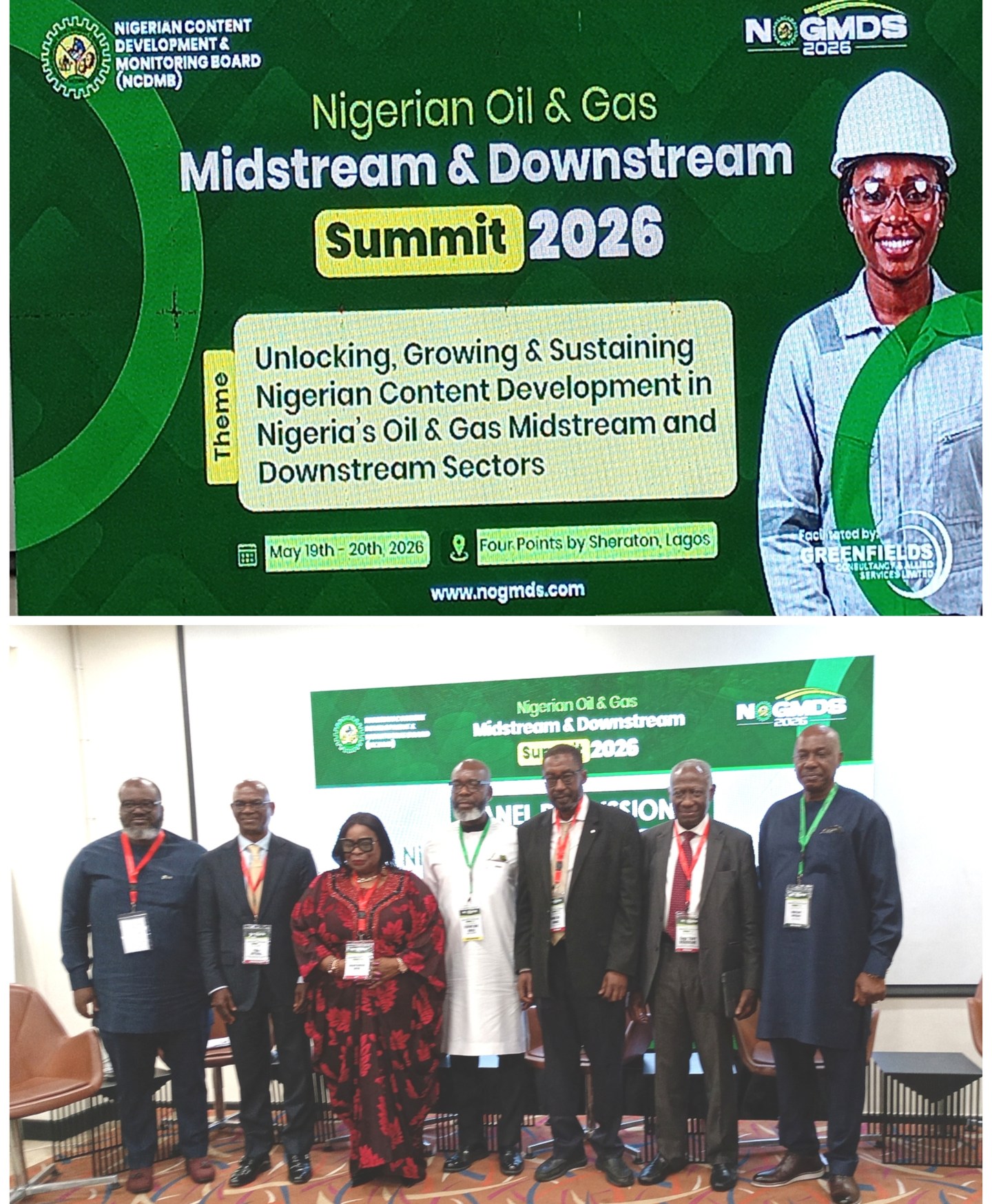
NCDMB pushes stronger local content, investment in Midstream, Downstream Oil and Gas Sectors
Nigeria’s oil and gas industry stakeholders have called for stronger local content development, stable regulations, expanded infrastructure and deeper private sector participation to drive sustainable growth across the sector.
The call was made at the 2026 Nigerian Oil and Gas Midstream and Downstream Summit held in Lagos, themed: “Unlocking, Growing and Sustaining Nigerian Content Development in Nigeria’s Oil and Gas Midstream and Downstream Sectors.”
Industry experts, Mr. Tony Ogbuigwe and Mr. Patrick June, presented outlooks on reforms, opportunities, challenges and future growth projections for the industry.
Speaking on the state of the sector, Ogbuigwe said Nigeria remained one of Africa’s leading hydrocarbon producers, with proven reserves of about 37 billion barrels of crude oil and 206 trillion cubic feet of natural gas.
He said crude oil production currently fluctuates between 1.2 million and 1.5 million barrels per day, depending on operational conditions and OPEC quotas.
According to him, the Petroleum Industry Act (PIA) 2021 has improved transparency, strengthened regulation and boosted investor confidence across the oil and gas value chain.
Ogbuigwe described the midstream sector — including gas processing, transportation, storage and LNG operations — as increasingly critical to Nigeria’s economic growth and energy security.
He noted that reforms in the downstream segment under the Nigerian Midstream and Downstream Petroleum Regulatory Authority were driving improvements in refining, distribution and petroleum marketing.
He added that gas commercialisation, domestic refining expansion and investments in pipelines, storage facilities and modular refineries would play major roles in shaping the future of the industry.
On global energy trends, Ogbuigwe projected that the global oil and gas market would grow from 6.33 trillion dollars in 2025 to 8.79 trillion dollars by 2034, driven by rising energy demand.
He said Africa was expected to sustain strong petroleum demand through 2040 and 2050, unlike some advanced economies where demand was projected to decline due to faster energy transition policies.
According to him, slower adoption of ultra-low sulphur fuels, limited use of advanced vehicle technologies and a gradual shift to renewable energy would continue to support fuel demand across the continent.
He also stressed that clean fuel policies alone would not sufficiently address environmental concerns without cleaner vehicle technologies, stricter emissions standards and improved energy efficiency systems.
Ogbuigwe identified refinery rehabilitation, modular refining, digitalisation, automation, pipeline optimisation, multimodal transportation and LNG infrastructure expansion as key drivers of growth in the sector.
He said Nigeria’s midstream and downstream sectors were gradually moving toward greater private sector participation, stronger regulatory oversight, improved domestic refining capacity and deeper gas-based industrialisation.
He added that sector performance would continue to be measured through indicators such as crude oil output, gas production, LNG exports, refining capacity, infrastructure development, investment flows, workforce capacity, environmental sustainability and local content compliance.
In a separate presentation titled “The Local Content Journey,” June said Nigerian content development in the oil and gas industry had grown from less than five per cent in 2010 to 61 per cent in 2025.
He disclosed that the industry currently supports more than 11,900 jobs in operating companies and over 129,000 jobs in service companies, with individual registrations in the sector exceeding 414,000.
According to him, Nigeria now has 50 fabrication yards, 20 design engineering companies and 122 manufacturing firms supporting indigenous participation in the petroleum industry.
June said sustainable local content development would depend on strong regulation, market access, funding support, capacity building, incentives, research and development.
He identified key performance indicators in the midstream and downstream sectors to include operational efficiency, storage capacity, distribution systems, infrastructure reliability, revenue generation, gas commercialisation and governance compliance.
He also stressed the importance of local workforce participation, use of indigenous goods and services, technology transfer and capacity development initiatives.
Despite ongoing progress, June identified pipeline vandalism, infrastructure deficits, foreign exchange challenges, supply chain inefficiencies and regulatory uncertainty as major obstacles facing the industry.
He warned that oil price volatility, environmental concerns and global energy transition pressures remained significant risks to long-term sector growth.
However, he said emerging opportunities in gas commercialisation, LNG, LPG, compressed natural gas, digitalisation and private sector investment were repositioning the industry into a more competitive and technology-driven sector.
June maintained that sustained investment, policy stability, technology adoption and stronger local participation would be essential to building a resilient and globally competitive petroleum industry capable of supporting Nigeria’s long-term economic growth and energy security.
The summit attracted regulators, operators, investors and stakeholders from across the oil and gas value chain.
