

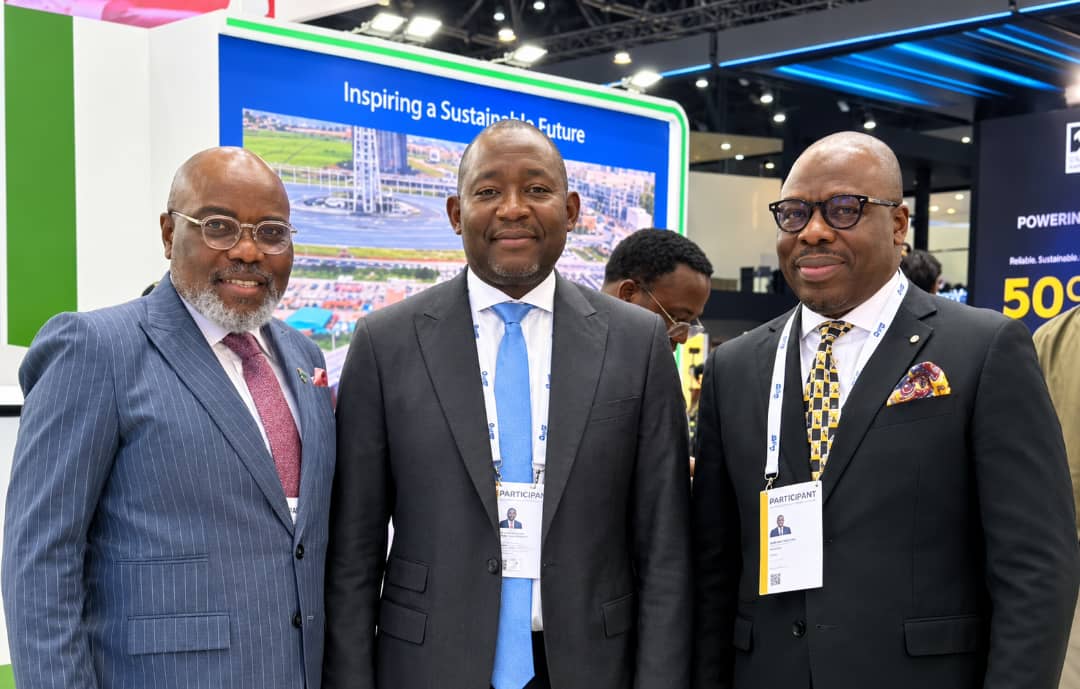
BANGKOK’S GAS SIGNAL: NIGERIA IS NO LONGER SELLING A RESOURCE STORY — IT IS SELLING AN ENERGY BUSINESS CASE
By Kunle Odusola-Stevenson

BANGKOK — Something has shifted in the way Africa’s gas opportunity is being discussed.
By Day Three of Gastech 2026, Nigeria’s conversation had moved beyond the familiar language of reserves, potential and the perennial call for investment. Across the stages of the Bangkok International Trade & Exhibition Centre, a more commercially significant proposition was emerging:
Africa’s gas challenge is no longer primarily a resource problem. It is a value-chain problem.
Nigeria illustrates this perfectly. Its substantial gas resources have long represented enormous potential, but their economic value depends on the systems that connect production to markets: regulation, infrastructure, finance, technology, domestic demand and execution.
That was the more consequential story emerging from Bangkok.
Building a market around the resource
Mallam Rabiu Abdullahi Umar, Authority Chief Executive of the Nigerian Midstream and Downstream Petroleum Regulatory Authority (NMDPRA), represented the institutional foundation of that transition.
For an industry that requires long-term capital, regulation is inseparable from investment. Pipelines need viable commercial structures. Processing plants need predictable supply and dependable customers. Gas-to-power projects need reliable fuel and sustainable payment arrangements.
Nigeria therefore has to make its gas market increasingly predictable for producers, consumers and investors.
The principle is straightforward:
Resources create potential. Functioning markets create value.
Competing in the global LNG market
That value chain extends beyond Nigeria’s borders.
Adeleye Falade, Managing Director and CEO of Nigeria LNG Limited, brought the global LNG dimension into focus.
International buyers are increasingly looking beyond price and volume to reliability, supply-chain performance and emissions intensity. Methane management and operational efficiency are consequently becoming commercial considerations alongside environmental priorities.
Nigeria’s LNG proposition must evolve with that market: reliable supply, competitive economics and credible environmental performance.
The objective is not simply to sell more LNG. It is to remain a dependable supplier as the global market becomes more discerning.
The domestic multiplier
Yet exports tell only part of Nigeria’s gas story.
At the Gastech session, “Rising Economies, Rising Demand: How the Next Industrial Age Gets Powered,” the discussion turned to a question more fundamental to Africa’s development: how can rapidly growing economies convert rising energy demand into productive capacity?
Osayande Igiehon, CEO of Heirs Energies, brought the Nigerian experience into that debate, highlighting the company’s growth in gas production and its focus on domestic power generation and industrial activity.
The economic logic is straightforward.
Reliable gas can strengthen electricity generation. Electricity supports manufacturing. Gas provides feedstock for fertiliser and petrochemicals. Industrial activity, in turn, generates demand across finance, logistics, engineering and services.
This is why domestic utilisation deserves to sit alongside exports in Nigeria’s gas strategy.
The value of gas rises as it moves deeper into the productive economy.
From foreign capital to strategic partnership
That expansion, however, requires capital and capability.
Dr Ainojie ‘Alex’ Irune, Managing Director of Oando Energy Resources, emphasised strategic partnerships, capital allocation and indigenous capacity.
Africa needs international finance and technology, but it also needs African companies with the technical and commercial capability to operate assets, manage risk and partner effectively.
The objective should be a stronger investment ecosystem in which global capital, technology and African enterprise reinforce one another.
The financing challenge then becomes more specific.
Roberto Lorato, Commissioner of MedcoEnergi, offered a Southeast Asian perspective: strong energy demand does not automatically translate into infrastructure investment.
Projects still have to be bankable.
Investors need credible revenues, reliable counterparties, appropriate risk allocation, regulatory certainty and returns commensurate with risk.
For Africa, that means moving beyond announcing opportunities to developing projects capable of reaching financial close.
The wider industrial opportunity
Once that happens, the gas opportunity becomes much larger than an upstream or LNG proposition.
It extends into processing, pipelines, power generation, fertiliser, petrochemicals, manufacturing, logistics, shipping, industrial parks and digital infrastructure.
These sectors are interconnected.
More reliable gas can support power. Better power can support industry. Growing industry can justify new infrastructure. New infrastructure can attract additional investment.
That is how an energy resource becomes an economic platform.
For Africa, the timing is critical. Population growth, urbanisation, industrialisation and rising electricity demand are occurring alongside the global transition towards lower-carbon energy systems.
Natural gas is not a substitute for renewables or energy efficiency. But in energy-deficient economies, it can provide dependable power and industrial feedstock while broader energy systems evolve.
What Bangkok should tell investors
The Nigerian voices at Gastech captured different dimensions of this emerging proposition.
Mallam Rabiu Abdullahi Umar brought the regulatory and market perspective.
Adeleye Falade addressed global LNG competitiveness.
Osayande Igiehon demonstrated the case for domestic utilisation and energy sufficiency.
Dr Ainojie ‘Alex’ Irune highlighted indigenous capability and strategic partnerships.
Roberto Lorato underscored the commercial discipline required to turn demand into investable infrastructure.
Together, they point to a more useful question for Africa.
Not simply:
How much gas do we have?
But:
How effectively can we connect that gas to markets, capital and productive economic activity?
That is the measure that will determine whether Africa’s gas resources remain largely potential or become a foundation for industrial growth.
The Bangkok signal
For global investors, the opportunity therefore extends well beyond another gas field or LNG cargo.
It lies in the infrastructure connecting resources to markets, the technology improving performance, the projects creating industrial demand and the companies capable of executing at scale.
Nigeria is beginning to articulate that proposition with greater commercial clarity.
Not simply:
“We have gas.”
But:
“Here is what this gas can build.”
That is a more consequential conversation for Africa.
The continent’s next energy story should not be written solely in cubic feet or tonnes of LNG. It should be measured in power generated, industries established, businesses created, infrastructure financed and economic value retained.
That is the real signal from Bangkok.
Nigeria is no longer selling a resource story. It is selling an energy business case.
The ultimate test, however, will not be another conference or investment pitch.
It will be what Nigeria — and Africa — build with the gas.
By Kunle Odusola-Stevenson
CEO, The Legend and Legacy Company Ltd | Conference Producer, Nigeria International Energy Summit (NIES)
