

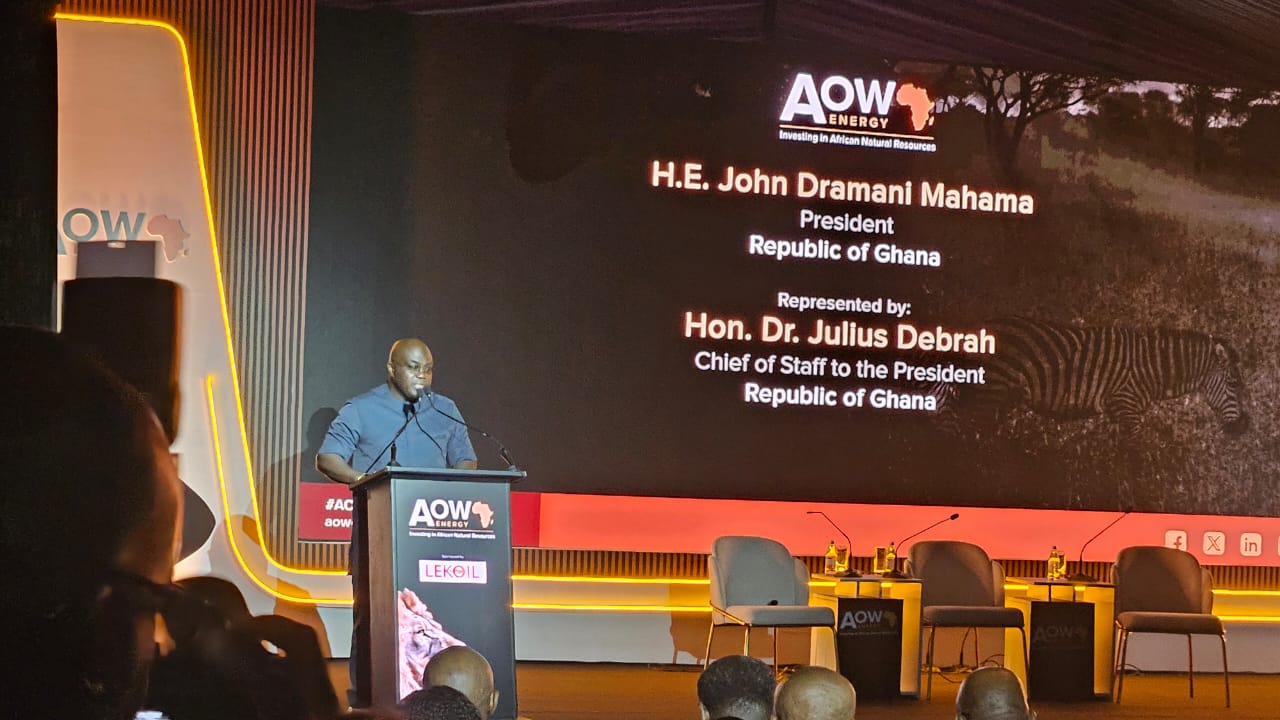
AOW 2026: Africa needs oil, gas and renewables to end energy poverty — Mahama
Ghana President says Africa’s energy transition must move from “poverty to prosperity”
President John Mahama of Ghana has called for a pragmatic and development-focused energy transition that combines oil, gas and renewable energy to end energy poverty, drive industrialisation and create jobs across Africa.
Mahama said Africa could not afford an energy transition that replaces energy poverty with economic disruption, insisting that the continent must design a transition that reflects its development realities.
“Africa must define its own transition — one that accounts for our development realities. We are not transitioning from abundance. We are transitioning from poverty to prosperity,” he said.
Mahama made the remarks in his presidential address at the opening ceremony of AOW: Energy Week 2026 in Accra, Ghana. He was represented at the event by his Chief of Staff, Hon. Dr. Julius Debrah.
The theme of AOW: Energy 2026 is “Investing in African Natural Resources,” with discussions focused on accelerating exploration, unlocking upstream partnerships and aligning policy, infrastructure and markets.
Africa must use energy wealth to drive development
Mahama said Africa is at a defining point in its development, but persistent energy deficits continue to constrain industrialisation and job creation.
“Africa is at a redefining point, yet energy assets still constrain industrialisation and job creation,” he said.
He called for greater investment to develop Africa’s energy resources and create jobs, stressing that the continent must use its energy wealth as a foundation for industrialisation and shared prosperity.
The President highlighted the scale of Africa’s energy challenge, noting that more than 600 million Africans lack access to electricity, while about one billion people lack access to clean cooking.
He also noted that more than 80 per cent of the global population without access to electricity lives in Africa, while rural electrification across the continent averages only about 25 per cent.
“Renewables are important. But oil and gas remain critical for industrialisation and for providing the cheap, reliable base energy that every past industrialiser used,” he said.
Ghana open for energy investment
Mahama said his administration has taken steps to restore confidence in Ghana’s petroleum sector while ensuring that the country secures fair and sustainable returns from its natural resources.
“Since assuming office, Ghana has taken steps to restore confidence in its petroleum sector while ensuring it receives fair and lasting returns from its resources. Our message is clear: Ghana is open for business,” he said.
He stressed that Africa must develop its hydrocarbon resources while simultaneously building a sustainable energy future, strengthening regional cooperation and mobilising both African and international capital.
“Government will continue to support energy infrastructure and prioritise Ghana’s interest while being open to international partnerships,” he said.
From barrels and cubic feet to value creation
Mahama called for a shift in how Africa measures success in the energy sector, arguing that the focus should move beyond production volumes to the value created for citizens.
He called for greater investment in refining, petrochemicals and local content, pointing to Ghana’s experience as an example.
According to him, the government reversed plans to sell the country’s refinery, and less than two years later, the facility was operating and processing domestic crude.
He also said increased use of domestic gas for thermal power generation had reduced liquid-fuel imports and saved Ghana about $500 million in one year.
The government, he added, is reforming the fiscal regime, including reducing the Ghana National Petroleum Corporation (GNPC) interest from 15 per cent to 10 per cent and extending the duration of petroleum agreements from 10 to 25 years.
“Natural gas will remain central to Ghana’s energy transition,” Mahama said, adding that the country would continue working with partners to create a conducive environment for investment.
Regional cooperation critical
Mahama also called for stronger cross-border energy infrastructure and regional cooperation.
He cited the West African Gas Pipeline and Ghana’s electricity exports to Burkina Faso, Togo, Benin and Côte d’Ivoire as examples of how regional energy cooperation can support economic development.
He said Nigeria’s gas exports to the region also demonstrate the potential for deeper integration of Africa’s energy markets.
According to Mahama, Africa must move quickly to attract capital as global energy investment becomes increasingly selective and energy policies evolve in major markets.
He urged African governments to provide predictable policies, credible institutions and an investment environment capable of attracting long-term capital.
AOW must translate into projects and jobs
Mahama challenged AOW to move beyond dialogue and become a platform for tangible investment and development outcomes.
“AOW must be more than a conference,” he said. “It must drive investments, into partnerships, into projects, into jobs, industries, revenue, and reliable energy.”
He called for “courage for bold policy choices, discipline to build credible institutions, and partnerships to mobilise the investments Africa needs.”
For Africa, Mahama’s message was clear: the continent does not have to choose between hydrocarbons and renewables. Its priority must be development, energy security and prosperity for its people.
