

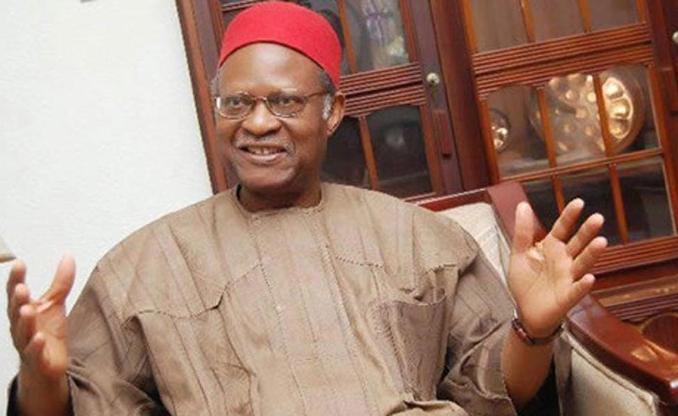
Anyaoku warns against delayed new constitution to manage Nigeria’s diversity
Abuja, Aug. 2026 – As Nigeria prepares for the next cycle of crucial national elections in January/February 2027, elder statesman Chief Emeka Anyaoku, an internationally renowned diplomat and Commonwealth Secretary-General (1990-2000), insists that Africa’s most populous nation requires a brand new constitution to address its diversity and the lingering concerns of its constituent/federating units.
“The 1999 Constitution (as amended) is unamendable,” he told this writer in a chat on Tuesday, 18 August. “I do not believe in the piecemeal amendments of a document that is basically defective.”
After a long spell of army rule, the military handed power to civilians in Nigeria with the 1999 constitution, which has undergone a series of alterations costing the country millions of dollars. However, the calls for further amendments and a new constitution persist even after an expensive National Conference in 2014, whose report remains unimplemented.
Chief Anyaoku reiterated his long-held position that Nigeria needs a new constitution, which should be a product of “a Constituent Assembly comprising representatives of various ethnic nationalities, faith and traditional institutions, professional bodies and other interest groups, after consultations with the relevant stakeholders.”
“That is the only way the country can get a “Constitution by the People,” he said, adding that the new constitution should take into consideration relevant provisions of Nigeria’s 1960 and 1963 constitutions (when the country operated a federation of three/four regions), and relevant recommendations of the 2014 National Conference.
Chief Anyaoku insists that the new constitution as the Grund norm should “define the formula for resource allocation and the devolution of power from the Centre to the federating units.
“We all hope there would be elections in 2027,” the elder statesman said, a reference to the unending political tensions in the country, adding: “The problem is always what happens after an election.”
Chief Anyaoku advised that the administration that emerges from the 2027 elections “must immediately begin the process of producing a new constitution; otherwise, the country is doomed.”
Nigeria is facing severe security challenges with incessant killings and abductions for ransom. Senior serving and retired military officers, teachers and students are among the victims.
Farmers are afraid to go to their farms or are made to pay taxes to non-state criminal armed gangs, resulting in food insecurity, with Nigeria ranking 115 out of 123 under the 2025 Global Hunger Index. According to a World Bank Report in April 2026: Nigeria’s poverty rate rose to 63%, “despite a slowdown in inflation, indicating the limited impact of recent macroeconomic improvements on household welfare.”
Despite the efforts by the government and external support, including from the United States, the bandits and armed religious extremist groups, especially Boko Haram, appear relentless in their onslaughts.
With political campaigns expected to kick off soon, concerned Nigerians, including a non-partisan group, The Patriots led by Chief Anyaoku, have lamented “the collapse of public institutions and declining leadership values in the country,” urging Nigerians to support only candidates and parties committed to restructuring Nigeria’s governance system in the forthcoming elections.
On electoral participation, the Patriots have criticised “the high cost of politics in Nigeria,” arguing that “the exorbitant fees for nomination and expression of interest forms had shut ordinary citizens out of the political process.”
As a patriot, with unalloyed commitment and immense contributions to the entrenchment of multiparty democracy in different parts of the world, from Bangladesh to Kenya, Zimbabwe, South Africa, and in his home country, Chief Anyaoku has consistently proffered pathways for Nigeria to exit its lingering governance challenges.
“I have said what I need to say about the way forward in my country,” he affirmed.
Chief Anyaoku pioneered what morphed into the now-famous National Peace Accord. At a critical juncture when Nigeria teetered on an existential brink in 2015, following the killings and widespread violence that followed the 2011 presidential election, Chief Anyaoku with the help of Senator Ben Obi, then political adviser to the President, crafted a one-page watershed document, which later became the Abuja Peace Accord.
He enlisted the support of the then-Secretary General of the United Nations, Kofi Annan of Ghana, and both men were able to persuade the 12 presidential candidates, including then-President Goodluck Jonathan, candidate of the ruling People’s Democratic Party (PDP), and Gen. Muhammadu Buhari, the flag-bearer of the opposition All Progressives Congress (APC) to sign the Abuja Peace Accord.
Chief Anyaoku and his co-peacemaker, Annan, now of blessed memory, witnessed the signing ceremony, with the candidates all committing to a non-violent election and pledging to respect the outcome of the poll.
Chief Anyaoku said it was one of the rare occasions that President Jonathan and Gen. Buhari embraced each other, and many believe that the peace effort effectively doused the political tension in the country and contributed to President Jonathan’s concession of defeat to Buhari in the 2015 election.
To build on that achievement, Chief Anyaoku said, he suggested that a mechanism be set up and recommended two key members of what became the National Peace Committee – former Head of State Gen. Abdulsalami Abubakar as the Chair, and Bishop Matthew Kukah as a member, with his Kukah Centre, to serve as the Committee’s Secretariat.
When the country faced another political crisis in 1998 following the 1993 elections annulled by the military, Chief Anyaoku and Kofi Annan were also involved in well-documented diplomatic peace initiatives.
Nigeria is once again in the throes of political uncertainty, with much hinging on the 2027 elections amid tensions and ominous signs.
In the run-up to the just-concluded 15 August off-season governorship election in the western state of Osun, the federal government’s anti-graft agency, EFCC, suspended one of the state government’s bank accounts over alleged fraud. It took the intervention of President Bola Tinubu for the suspension to be lifted.
In the ensuing political violence, hate speech, allegations and counter-allegations of intimidation by the political parties, especially the ruling APC and the sitting governor’s Accord Party, at least 29 deaths were recorded, according to the Pre-Election Security Risk Assessment (ESRA) by the Kimpact Development Initiative (KDI)
Despite the pre-election tensions, polling was generally peaceful on election day, except for vote-buying, voter-inducement, and other incidents reported by civil society groups, including Yiaga Africa.
There was also heavy security deployment, including 15,000 police personnel, and large delegations of the ruling APC chieftains, including state governors, virtually relocated to Osun State to campaign for the party’s flag-bearer. In the end, the Accord Party’s governor was reelected.
Chief Anyaoku said “two lessons can be drawn from the outcome of the Osun election ahead of Nigeria’s January/February 2027 general elections.
“One of the lessons is possible consolidation of the process to ensure free expression of the will of the people,” he said, adding that the other possible lesson is that the losers could plug identified loopholes and roll back the gains.
Ejime is a Global Affairs Analyst and an Independent Consultant on Corporate Strategic Communication, Media Development, Security and Elections
