

Stakeholders urge women to unlock Africa’s $300bn blue economy
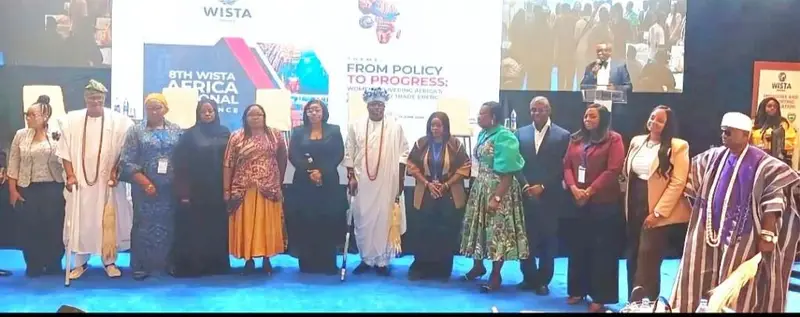
Group photograph of stakeholders and royal fathers who graced the second day of the 8th WISTA Africa Regional Conference in Lagos on Friday
Lagos, June 2026 (TBL Africa) Minister of Marine and Blue Economy and maritime stakeholders have urged women to spearhead implementation of policies that will unlock Africa’s 300 billion-dollar blue economy through sustainable shipping.The call was made on Friday at the two-day Regional Conference of the Women in Shipping and Trading Association (WISTA) Nigeria in Lagos.
The conference has its theme as, “From Policy to Implementation: Women Advancing Africa’s Blue Economy through Sustainable Shipping, Trade and Energy Innovation”.
The conference attracted policymakers, regulators and maritime professionals from across Africa and beyond.
The Minister of Marine and Blue Economy, Dr Adegboyega Oyetola, represented by Hajia Kaltum Ibrahim, Director of Planning, Research and Statistics from the ministry, said the enormous potential of the sector could only be realised through effective implementation of policies and stronger collaboration among stakeholders.
He said the ministry had developed a comprehensive National Policy on Marine and Blue Economy to provide a strategic framework for sustainable development.
According to him, strategic public-private partnerships remain critical to attracting investment, driving innovation and expanding infrastructure across the maritime value chain.
Oyetola said sustainable growth required more than capital, stressing the need to translate policies into investments, jobs, economic opportunities and greater inclusion for women and youth.
He noted that women’s participation in the blue economy as a strategic economic imperative is capable of accelerating growth across shipping, logistics, fisheries, renewable energy and marine services.
The minister urged delegates to move beyond discussions by delivering practical outcomes that would strengthen Africa’s maritime competitiveness.
The Oniru of Iruland, Oba Abdulwasiu Lawal, said Lagos remained Africa’s leading maritime gateway and an appropriate venue for conversations on sustainable blue economy development.
Lawal said women’s leadership had become a business imperative, noting that greater participation would strengthen shipping, logistics, trade and investment across the continent.
He renewed his call for the establishment of a Lagos Coastal Community Development Corporation to promote inclusive coastal development and shared prosperity.
Delivering the keynote address, former Director-General of the Nigerian Maritime Administration and Safety Agency (NIMASA), Dr Dakuku Peterside, identified poor implementation rather than inadequate policy as Africa’s biggest maritime challenge.
He said frameworks such as the African Maritime Transport Charter and the African Continental Free Trade Area (AfCFTA) had yet to translate into improved port efficiency, fleet expansion and stronger intra-African trade.
Peterside noted that Morocco’s average vessel turnaround time of two days compared favourably with Nigeria’s minimum of seven days, warning that port inefficiencies ultimately increase business costs and reduce competitiveness.
He said Africa should leverage the global transition to net-zero emissions to attract green finance, develop shipbuilding capacity, modernise ports and establish efficient logistics corridors.
“Signature is not a shipyard. Convention is not capacity. Policy is not fleet. If we sign without building, we become spectators,” he said.
Peterside also called for regular efficiency audits and public performance reports to improve accountability across African ports.
The Director-General of NIMASA, Dr Dayo Mobereola, said Africa’s blue economy, valued at more than 300 billion dollars annually, required greater gender inclusion to realise its full economic potential.
Mobereola said maritime transport accounts for about 90 per cent of global trade by volume but women remain significantly underrepresented, accounting for only 29 per cent of the global maritime workforce and less than two per cent of seafarers.
He urged governments and industry operators to prioritise human capital development, institutional reforms and innovation while creating opportunities for women and young professionals.
The Deputy Speaker of the Lagos State House of Assembly, Hon. Mojisola Meranda, said Africa’s economic transformation depended on stronger female participation in maritime leadership.
She cited the 2024 IMO-WISTA Survey, which showed that women account for less than 19 per cent of the global maritime workforce and only one per cent of seafarers worldwide.
Meranda urged stakeholders to invest in training, mentorship, financing and policies that would expand women’s access to leadership and technical roles across the maritime sector.
A former President of WISTA Nigeria, Chief Jean Anishere, called for harmonised environmental and port regulations across Africa to reduce compliance costs, improve operational efficiency and attract investment.
She also advocated policies that would encourage renewable energy infrastructure, shore power facilities, alternative fuel bunkering and smart port technologies.
Earlier, the President of WISTA Nigeria, Dr Odunayo Ani, said the conference underscored Africa’s commitment to translating policy into measurable economic outcomes.
Ani noted that WISTA Nigeria, the first national WISTA association in Africa established 32 years ago, had continued to promote mentorship, advocacy and professional development across the maritime industry.
She said the establishment of the Federal Ministry of Marine and Blue Economy reflected the nation’s determination to harness marine resources for economic growth, employment generation and expanded regional trade.
