

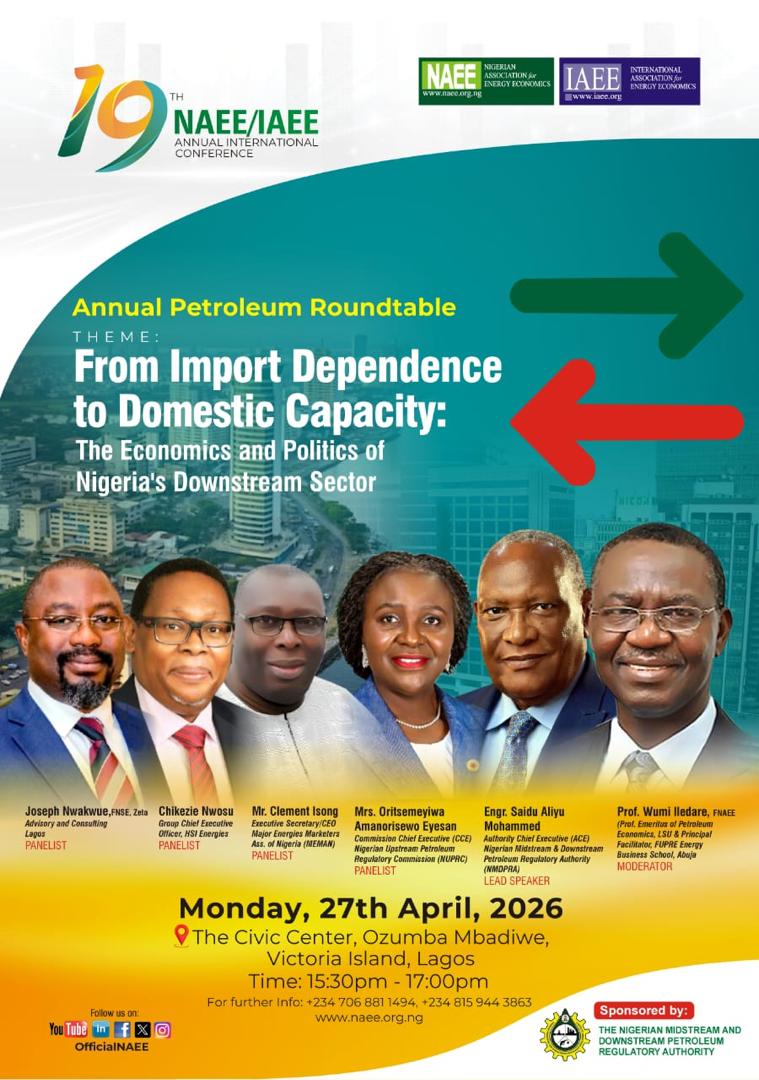
From import reliance to refining powerhouse: NAEE 2026 charts Nigeria’s Downstream Reset
Lagos — Nigeria’s long-standing dependence on imported petroleum products will come under sharp scrutiny as stakeholders convene for the NAEE 2026 Petroleum Roundtable, a high-level forum designed to map a realistic path toward domestic refining and energy self-sufficiency.
Organised under the theme “From Import Dependence to Domestic Capacity,” the roundtable will assemble key players across the value chain—including regulators, industry leaders, and policy experts—to interrogate the structural, economic, and political forces shaping Nigeria’s downstream petroleum sector.
At the heart of the discussions is a critical national question: how to transition from a system heavily reliant on fuel imports to one anchored on sustainable, locally driven refining capacity.
Participants are expected to examine the interplay between pricing frameworks, regulatory stability, and investment incentives—factors widely seen as decisive in unlocking domestic production and ensuring long-term sector viability.
Beyond technical considerations, the forum will also confront the broader implications of reform, particularly how to balance market efficiency with energy security and social welfare in a country where fuel pricing remains politically sensitive.
Organisers say the roundtable is not merely a talking shop, but a solutions-driven engagement aimed at generating actionable insights and policy direction.
By aligning investment signals with clear regulatory frameworks, stakeholders hope to chart a course that strengthens domestic value creation, reduces exposure to global supply shocks, and ultimately repositions Nigeria as a refining hub rather than a net importer.
As pressure mounts on Africa’s largest oil producer to optimise its downstream potential, the outcomes of the NAEE 2026 Roundtable may well shape the next phase of Nigeria’s energy transition.
