

FG reaffirms commitment to energy security through domestic refining
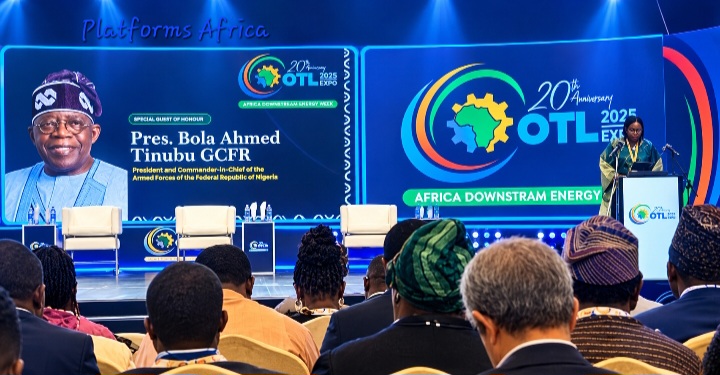
The Permanent Secretary, Federal Ministry of Petroleum Resources, Mrs Patience Oyekunle, speaking as representative of President Bola Tinubu at the OTL Africa Downstream Energy Week 2026 in Lagos
FG reaffirms commitment to energy security through domestic refining
The Federal Government has reaffirmed its commitment to strengthening energy security through domestic refining, improved crude supply and increased investment in the petroleum sector.
President Bola Tinubu, represented by the Permanent Secretary, Federal Ministry of Petroleum Resources, Mrs Patience Oyekunle, said that expanding domestic refining capacity and rehabilitating government-owned refineries were key to cutting dependence on imported products and positioning Nigeria as a regional energy hub.
Tinubu spoke at the ongoing 20th edition of OTL Africa Downstream Energy Week 2026 on Monday in Lagos.
He said that the ongoing petroleum sector reforms were designed to attract investment, strengthen domestic value addition and improve Nigeria’s competitiveness in regional energy markets.
Mrs Oritsemeyiwa Eyesan, the Chief Executive of the Nigerian Upstream Petroleum Regulatory Commission (NUPRC), represented by Mr Prosper Omoneto, a director in the commission, said that reliable crude supply was essential to sustaining domestic refining and strengthening energy security.
Eyesan said that the Petroleum Industry Act provided for domestic crude supply obligations, but noted that supply to local refineries had faced challenges, including commercial disagreements between suppliers and refiners operating under a willing-buyer, willing-seller framework.
She said that the commission was consulting on a proposed crude-swap framework that could enable refiners to receive crude oil from production or export points closer to their facilities, to reduce transportation costs and address logistical challenges.
Gov. Babajide Sanwo-Olu of Lagos State, represented by the Commissioner for Energy and Mineral Resources, Mr Biodun Ogunleye, said the success of energy reforms should be judged by their impact on transportation costs, food distribution and business expenses.
Sanwo-Olu said that energy costs directly affected household expenditure and business operations, stressing that reliable and affordable energy was necessary to lower operating costs and support economic activities.
Mr Tajudeen Abbas,the Speaker of the House of Representatives, represented by Mr Peter Aniekwe, said domestic refining could retain more economic value within Nigeria and create employment.
Abbas said that domestic production alone would not insulate Nigeria from disruptions in the global oil market.
He added that effective regulation, reliable distribution networks and sustained investment were equally necessary to strengthen energy security.
He reaffirmed the National Assembly’s commitment to supporting implementation of the Petroleum Industry Act and exercising oversight over policies and investments in the sector, stressing that reforms must translate into tangible benefits for Nigerians.
Mr Farouk Ahmed, a former Authority Chief Executive of the NMDPRA, said that predictable regulation was essential to attracting investment into the downstream petroleum industry.
Ahmed said that consistent enforcement, transparent decision-making and effective stakeholder consultation would strengthen investor confidence and support sustainable growth.
He identified infrastructure gaps, financing constraints, product quality and supply-chain efficiency as challenges requiring sustained attention.
He called for stronger regional cooperation, technology adoption and workforce development to improve the resilience of petroleum markets.
The 4-day OTL Africa Downstream Energy Week, holding from Oct. 26 to Oct. 29, with the theme,“Secure Energy, Shared Prosperity”.
