

Zamfara unveils electricity policy, partners REA on solarisation of public institutions
…Tegbe commissions 2.2MW solar projects, unveils 100 electric taxis
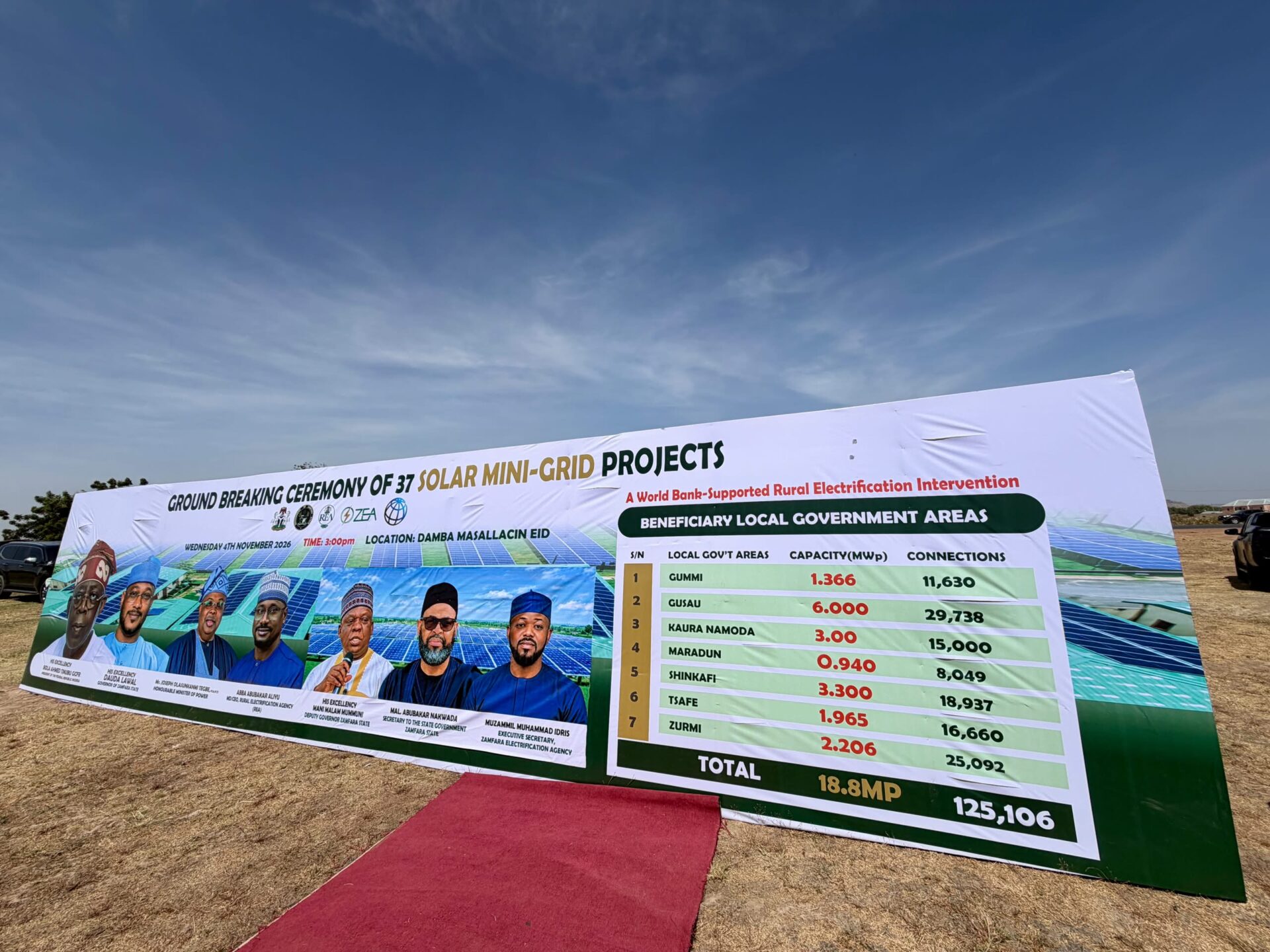
 L-R: Zamfara State Governor, Dauda Lawal, one of the develeopers, Minister of Power, Joseph Tegbe and Managing Director of the Rural Electrification Agency (REA), Abba Aliyu at the groundbreaking of 37 mini-grid projects across seven Local Government Areas of Zamfara State
Zamfara Government has unveiled its electricity policy and signed a collaboration agreement with the Rural Electrification Agency (REA) to solarise public institutions across the state as part of efforts to expand electricity access and strengthen energy security.
The initiative coincided with the groundbreaking of 37 mini-grid projects across seven Local Government Areas (LGAs), with a combined planned solar generation capacity of 18.777 megawatts-peak (MWp) and 125,106 electricity connections.
The projects were unveiled at an event attended by the Minister of Power, Chief Joseph Olasunkanmi Tegbe; Gov. Dauda Lawal of Zamfara; and the Managing Director/Chief Executive Officer of REA, Dr Abba Aliyu.
The newly unveiled Zamfara State Electricity Policy provides a framework for developing an investment-friendly state electricity market in line with the opportunities created by the Electricity Act 2023.
The agreement between the state government and REA is designed to expand renewable electricity supply to public institutions, including hospitals, schools and other essential government facilities.
Speaking at the event, Lawal described the policy and partnership as significant milestones in the state’s economic development agenda.
He said reliable electricity was essential for agricultural transformation, industrial development, healthcare delivery, education and job creation.
“Today, we are taking deliberate steps to redefine Zamfara’s electricity future. The unveiling of our State Electricity Policy is a statement of our intention to build a structured, investment-friendly and sustainable electricity market that responds to the needs of our people and the ambitions of our economy.
“Our collaboration with the Rural Electrification Agency on the solarisation of public institutions reflects our determination to translate policy into practical infrastructure that improves the delivery of essential services,” he said.
The governor said the government was committed to making renewable energy a driver of enterprise development, economic opportunities and prosperity across the state.
He added that the government would provide an enabling environment for private investors to contribute capital and innovation to the electricity market.
Also speaking, Tegbe described the initiative as evidence of the Federal Government’s commitment to expanding electricity access through decentralised infrastructure, state-level market development and private-sector investment.
He said electricity development must go beyond providing lighting to supporting hospitals, educational institutions, agricultural productivity, businesses and public services.
“The unveiling of the Zamfara State Electricity Policy, the groundbreaking of new mini-grid infrastructure and the commissioning of renewable energy projects demonstrate how policy reforms can be translated into practical development outcomes.
“The Federal Government will continue to support states that are taking practical steps to develop their electricity markets and create the conditions necessary for sustainable private investment,” he said.
As part of the activities, the minister commissioned two solar mini-grid projects developed by the Zamfara Government.
The projects comprise a 1MW solar mini-grid at Yariman Bakura Specialist Hospital and a 1.2MW facility serving the Zamfara Government House.
The two projects have a combined generation capacity of 2.2MW, supported by more than 3MW of battery storage.
Tegbe also unveiled 100 ZamTaxi electric vehicles as part of efforts to promote clean transportation.
Additionally, 10 electric tricycles dedicated to maternal healthcare services were unveiled to improve transportation access for pregnant women and nursing mothers.
Two Compressed Natural Gas (CNG) buses donated by the Presidential Initiative on Compressed Natural Gas (Pi-CNG) were also unveiled.
In his remarks, Aliyu said the 37 mini-grid projects comprised two interconnected and 35 isolated systems, covering seven LGAs.
He said the projects would deliver approximately 18.777MWp of solar generation capacity and 125,106 planned electricity connections across the state.
According to him, the projects will cover Gummi, Gusau, Kaura Namoda, Maradun, Shinkafi, Tsafe and Zurmi LGAs.
Aliyu said the planned connections represented a potential reach of more than 625,000 people, using an illustrative average of five persons per household-equivalent connection.
He, however, clarified that the actual population reached would depend on the final mix of household, commercial and institutional connections.
The REA managing director said the intervention was designed not merely to expand electricity access but also to stimulate economic activities, strengthen agricultural value chains, support businesses and attract private investment.
He stressed that electricity infrastructure must be backed by clear policies, effective institutions, commercially viable tariffs and predictable investment conditions to ensure sustainability.
“Through the REA, we are advancing 37 mini-grid projects comprising two interconnected and 35 isolated systems, with approximately 18.777MWp of solar generation capacity and 125,106 planned electricity connections across seven Local Government Areas.
“The real economic significance of these connections is the number of businesses that can become productive, agricultural value chains that can be strengthened, jobs that can be created and private investments that reliable electricity can unlock,” he said.
Aliyu added that the partnership on public institution solarisation would help reduce dependence on expensive alternative electricity generation and improve the operational efficiency of healthcare facilities, schools and government establishments.
He explained that public institutions could also serve as anchor customers for renewable energy projects, improving their commercial viability and creating opportunities to extend electricity supply to surrounding communities.
The REA boss said the Zamfara intervention aligned with the broader national electricity access programme under the 750 million dollar World Bank-supported Distributed Access through Renewable Energy Scale-up (DARES) initiative.
He said the programme targeted electricity access for approximately 17.5 million Nigerians, alongside the development of about 1,350 mini-grids and expansion of distributed renewable energy solutions.
The REA’s planned electrification projects across the seven LGAs are distributed as follows:
LGA| Solar capacity| Planned connections
Gummi| 1.366 MWp| 11,630
Gusau| 6.000 MWp| 29,738
Kaura Namoda| 3.000 MWp| 15,000
Maradun| 0.940 MWp| 8,049
Shinkafi| 3.300 MWp| 18,937
Tsafe| 1.965 MWp| 16,660
Zurmi| 2.206 MWp| 25,092
Total| 18.777 MWp| 125,106
Aliyu said the agency would continue to support Zamfara through technical collaboration, project development and private-sector engagement, with emphasis on the commercial sustainability of electricity infrastructure.
He said the public institution solarisation partnership would also provide opportunities to develop scalable financing and implementation models that could be replicated in other states.
The initiative, he added, demonstrated how coordinated federal and state government interventions could translate electricity sector reforms into practical infrastructure, improved public services and economic opportunities.
