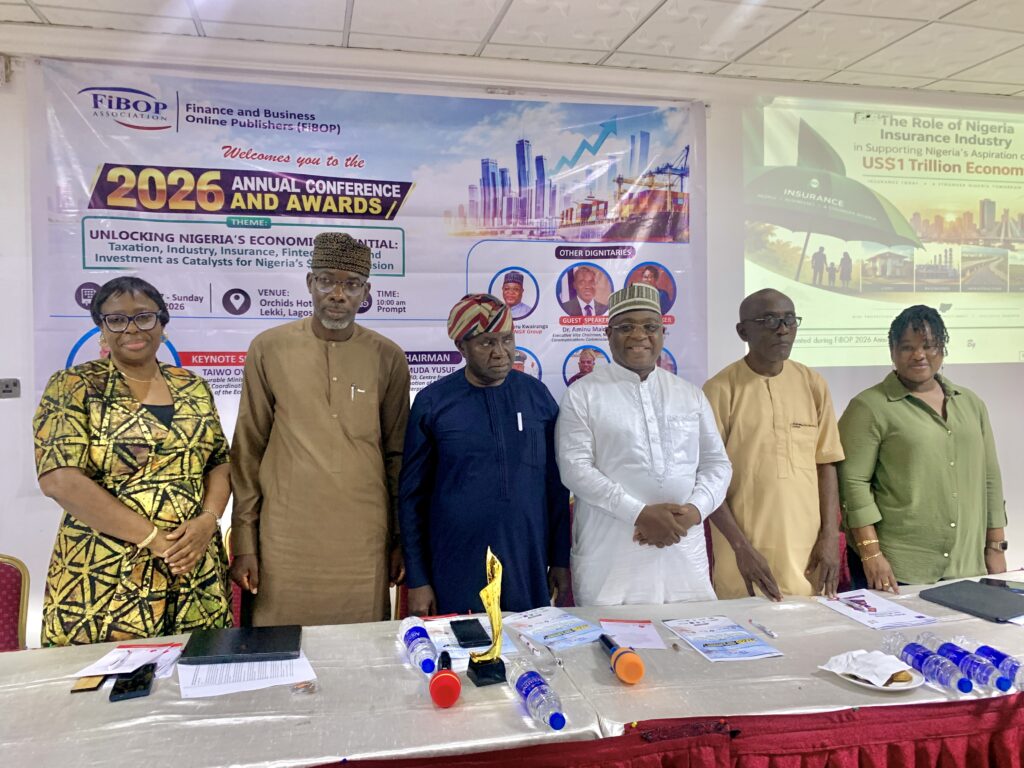
L-R: Mrs Bola Odukale, Director-General of the Nigerian Insurers Association, Mr Olufemi Olarinde, Special Adviser to the Minister of Finance, Dr Muda Yusuf, Chief Executive Officer of the Centre for the Promotion of Private Enterprise, Dr Umaru Kwairanga, Group Chairman of Nigerian Exchange Group and others at the Annual Conference and Awards of the Finance and Business Online Publishers Association in Lagos on Saturday
Charles Onwatogwu, President, Finance and Business Online Publishers Association at the association’s annual conference in Lagos on Saturday
Lagos, Oct. 2026 (TBL Africa) Economic and industry leaders have called for productive investment, efficient public spending and reforms to drive Nigeria’s ambition of building a $1 trillion economy.
They made the call at the 2026 Annual Conference and Awards of the Finance and Business Online Publishers Association (FiBOP) in Lagos on Saturday.
The conference, held at Orchids Hotel, had the theme: ‘Unlocking Nigeria’s Economic Potential: Taxation, Industry, Insurance, Fintech, Trade and Investment as Catalysts for Nigeria’s $1 Trillion Vision’.
Dr Muda Yusuf, Chief Executive Officer of the Centre for the Promotion of Private Enterprise (CPPE), chaired the occasion.
Yusuf said the ambition must translate into higher productivity, job creation, stronger businesses and improved living standards, rather than merely expanding the economy’s nominal dollar value.
He acknowledged improvements in foreign exchange conditions, moderating inflation and investor confidence, but warned that macroeconomic stability alone could not guarantee sustainable growth.
“The $1 trillion target should represent a diversified, competitive and resilient economy,” he said.
Yusuf urged federal, state and local governments to channel increased revenues into productive projects with measurable benefits for citizens.
He identified agriculture, transportation, healthcare and education as priority sectors requiring sustained investment.
He also called for greater scrutiny of public expenditure, stressing that Nigeria’s federal structure required accountability across all levels of government.
Yusuf urged journalists to hold elected officials accountable for their management of public resources.
Earlier, FiBOP President, Charles Onwatogwu, said achieving sustainable economic growth required collaboration among government, businesses and other stakeholders.
He identified consistent policies, infrastructure development, improved security and predictable regulation as essential conditions for investment.
Onwatogwu said taxation should expand government revenue without placing excessive burdens on households and businesses.
He advocated a shift from consumption and import dependence towards domestic production, value addition and exports.
He also called for affordable credit for small businesses and greater use of insurance and financial technology to support investment.
Onwatogwu said public spending must be efficient, while the media should demand measurable economic results from public institutions.
In a keynote presentation delivered on behalf of the Minister of Finance and Coordinating Minister of the Economy, Mr Taiwo Oyedele, Mr Olufemi Olarinde outlined the government’s tax reforms.
Olarinde, Special Adviser to the Minister on Revenue, said the reforms were designed to support business growth, protect vulnerable taxpayers and improve revenue mobilisation.
Oyedele said the $1 trillion ambition should be assessed by its impact on employment, business expansion, incomes and living standards.
He outlined four laws underpinning the new tax framework: the Nigeria Tax Act, Nigeria Tax Administration Act, Nigeria Revenue Service (Establishment) Act and Nigeria Revenue Board (Establishment) Act.
The News Agency of Nigeria (NAN) reports that the framework, which took effect on Jan. 1, 2026, seeks to simplify tax administration, reduce compliance costs and encourage productive investment.
The presentation highlighted a zero per cent company income tax rate for qualifying small companies, subject to statutory conditions.
Oyedele also reported that allocations from the Federation Account Allocation Committee rose from N15.2 trillion in 2024 to N21.9 trillion in 2025.
Federal tax collections increased from N12.3 trillion in 2023 to N21.3 trillion in 2024 and N28.3 trillion in 2025, according to figures presented.
He stressed the need for better coordination between fiscal and monetary policies, noting that borrowing costs and monetary conditions influenced businesses’ ability to invest.
Oyedele identified reliable electricity, efficient logistics, accessible finance, local manufacturing, agricultural processing and mineral value chains as priorities for sustainable economic growth.
He urged journalists to distinguish verified economic results from speculation and implemented policies from proposals.
The Group Chairman of Nigerian Exchange Group (NGX), Dr Umaru Kwairanga, said the capital market could provide long-term financing for infrastructure and productive enterprises.
Kwairanga disclosed that NGX market capitalisation had increased from below N50 trillion about three years earlier to more than N160 trillion.
He said the exchange aimed to increase investor participation to 10 million from fewer than five million.
Kwairanga said attracting more retail investors and international capital would deepen the market and improve businesses’ access to long-term funding.
He also identified reliable electricity, stronger banking institutions and support for small and medium-sized enterprises as essential to expanding economic activity.
He added that banking recapitalisation could strengthen credit provision, while pension funds offered opportunities to mobilise domestic capital for long-term investment.
The Director-General of the Nigerian Insurers Association (NIA), Mrs Bola Odukale, said insurance could protect businesses, mobilise long-term capital and support economic expansion.
Odukale said insurance penetration remained below one per cent despite growth in industry premiums.
She cited figures showing that gross premium written increased by 47.3 per cent to about N2.3 trillion in 2025, while industry assets exceeded N4 trillion.
Odukale said the Nigerian Insurance Industry Reform Act 2025 and the sector’s completed recapitalisation exercise were intended to strengthen insurers’ capacity and governance.
She said stronger insurers would be better equipped to underwrite complex risks and support investments in infrastructure, agriculture, manufacturing, energy, transport, housing and technology.
Odukale called for stronger enforcement of compulsory insurance requirements covering motor vehicles, buildings, construction and marine operations.
She identified fake motor insurance policies and low public awareness as persistent challenges facing the industry.
She added that insurers were working with Lagos State and other stakeholders on building insurance and measures addressing building-collapse risks.
Representing the Executive Vice-Chairman of the Nigerian Communications Commission (NCC), Dr Aminu Maida, Senior Manager, Mrs Yetunde Adeyemo, highlighted telecommunications’ contribution to economic growth.
Maida said telecommunications accounted for 9.19 per cent of Nigeria’s gross domestic product in the first quarter of 2026, according to industry data.
He said Nigeria had more than 188 million active telephone subscriptions and over 154.7 million active internet subscriptions as of April 2026.
He also cited 4G and 5G network usage figures of 54.41 per cent and 4.34 per cent, respectively.
Maida said broadband connectivity could expand markets, improve financial inclusion and public services, and create opportunities for digital businesses.
However, he identified high deployment costs, multiple taxation, fibre-optic cable cuts, unreliable electricity and inadequate rural coverage as barriers to connectivity.
He said inconsistent state right-of-way charges also complicated infrastructure deployment, with some states charging N1,000 per kilometre.
Others, he said, had agreed to N145 per kilometre, while some charged nothing, urging greater harmonisation.
Maida added that the NCC’s Digital Awareness Programme had connected schools or provided information and communications technology resources to more than 300 schools nationwide since 2006.
At the conference, Yusuf received the Economic Voice and Advocacy Personality of the Year award, while Kwairanga was named Capital Market Personality of the Year.
The Comptroller-General of the Nigeria Customs Service, Bashir Adeniyi, received the Transformative Reforms and Leadership Excellence Award.
Tosin Eniolorunda of Moniepoint received the Financial Inclusion and Digital Payment Company award, while several other individuals and organisations were recognised.
The speakers agreed that achieving Nigeria’s $1 trillion ambition would depend on translating reforms into productive investment, employment, stronger businesses and improved living standards.