

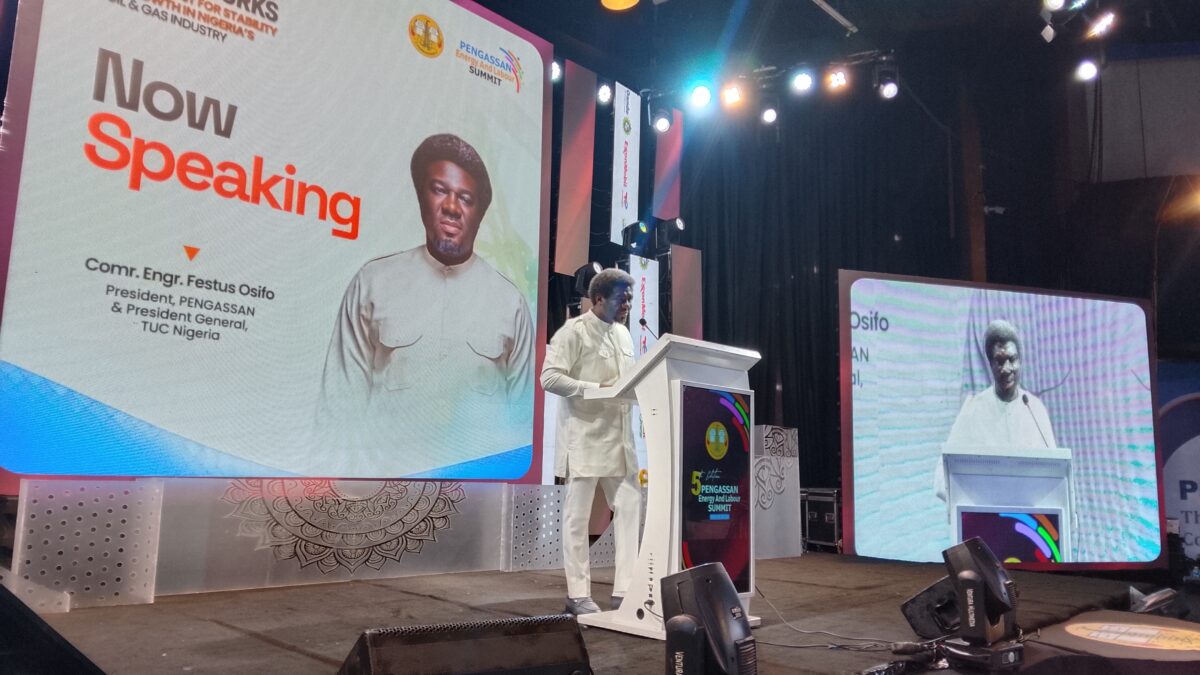
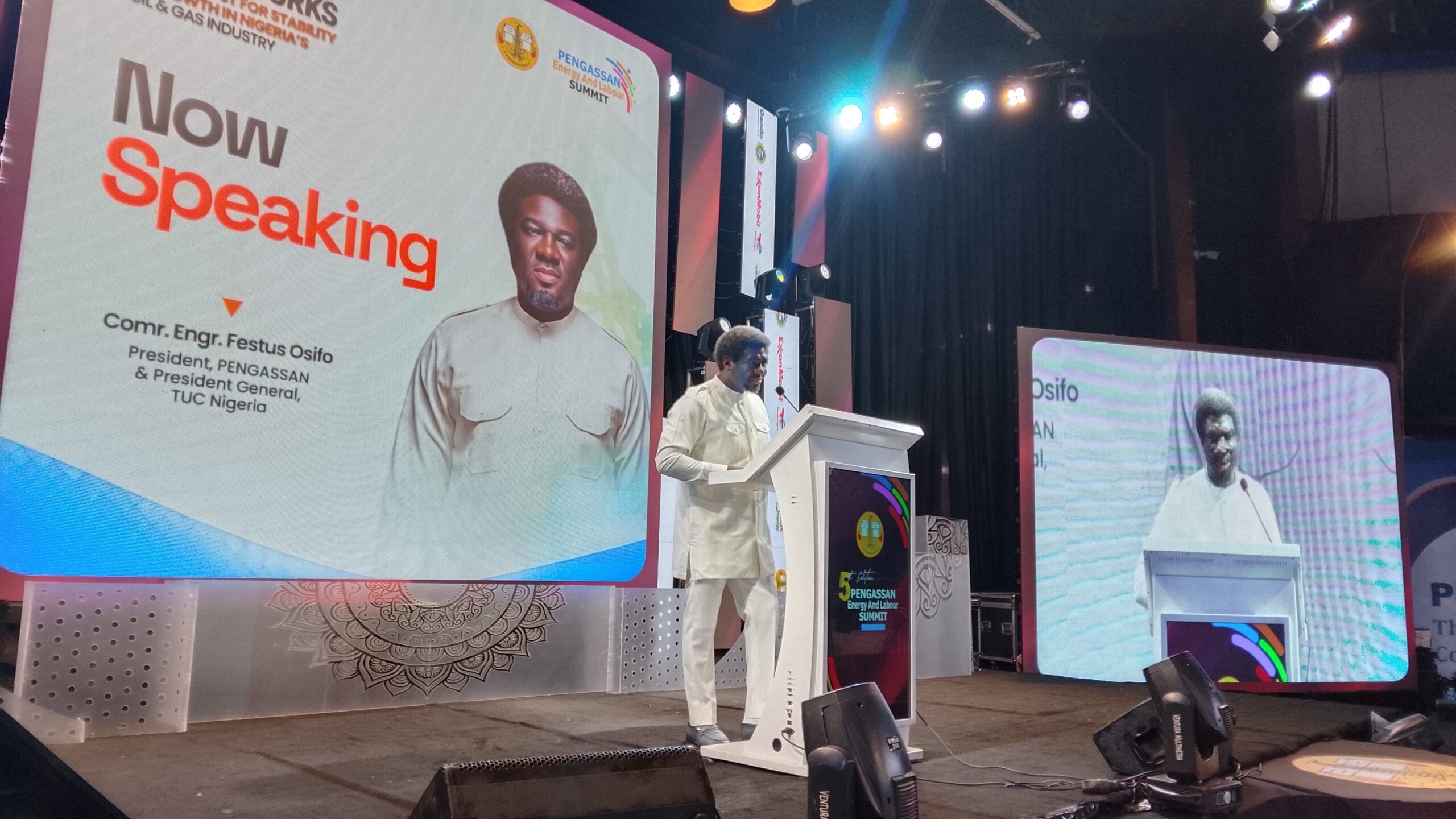
The President of the Petroleum and Natural Gas Senior Staff Association of Nigeria (PENGASSAN), Comrade Engr. Festus Osifo, has called for greater regulatory stability, faster approvals, stronger investment incentives and improved policy coordination to unlock sustainable growth in Nigeria’s oil and gas industry.




Osifo made the call on Friday in Abuja while presenting the communiqué of the 5th edition of the PENGASSAN Energy and Labour Summit (PEALS 2026), held from August 19 to 21 at the Congress Hall of Transcorp Hilton Hotel, Abuja.
The summit, themed “Strengthening Regulatory Frameworks as a Catalyst for Stability and Growth in Nigeria’s Oil and Gas Industry,” brought together representatives of the Federal Government, regulatory agencies, international and indigenous oil companies, organised labour, investors, industry professionals and other stakeholders.
The PENGASSAN president, who is concluding his six-year tenure in office, became emotional while reflecting on his years of service and the support he received from members of the association.


He expressed appreciation to PENGASSAN delegates, members of the various congresses, the Women Commission, the media and other stakeholders for their contributions to the achievements recorded by the association during his tenure.
“The successes that we have recorded in PENGASSAN would not have been possible if not for your commitment, dedication and the fact that you gave it all. I appreciate you from the depth of my heart,” Osifo said.
He added that the three-day summit had provided an opportunity for stakeholders to engage in critical conversations on the future of Nigeria’s energy sector, noting that PENGASSAN had continued to position itself as a major stakeholder in industry policymaking.
According to him, the communiqué represents the collective findings, resolutions and recommendations reached after extensive deliberations at the summit, maintained that regulatory stability critical to Investment
Presenting the communiqué, Osifo said the summit recognised the Petroleum Industry Act (PIA) 2021 as a significant milestone in Nigeria’s petroleum sector reforms but stressed that the availability of laws alone was not enough to attract long-term capital.
He said investors also require regulatory predictability, durability, transparency and consistency.
The summit therefore called on the government and regulatory institutions to minimise abrupt policy changes and ensure adequate consultation with stakeholders before introducing major changes to the regulatory and fiscal environment.
It also recommended smarter regulation, greater use of technology and improved coordination among government agencies to eliminate overlapping mandates, repetitive approvals and conflicting directives.
PENGASSAN further urged regulators to ensure that regulations protect national interests, workers, host communities, investors, safety and the environment without creating unnecessary barriers to legitimate businesses.
The association called for outcome-driven regulations supported by digitalisation, clear timelines, faster approvals and transparent processes.
It welcomed the commitment of the Nigerian Upstream Regulatory Commission (NUPRC) to continuously review regulations to determine whether they are achieving their intended objectives, while maintaining transparent and time-bound licensing processes.
On investment and production, the summit noted that Nigeria competes with other oil-producing jurisdictions for limited global capital and cannot depend solely on its huge hydrocarbon reserves to attract investors.
It called for competitive fiscal and commercial terms, improved security, predictable regulations and efficient project execution.
The summit also urged the government and regulators to consolidate recent reforms and incentives that have encouraged renewed investments and final investment decisions in the sector.
On gas, the summit described Nigeria’s estimated more than 200 trillion cubic feet of proven gas reserves as a major opportunity for industrialisation, but lamented the challenges preventing the country from fully converting the resource into economic value.
It called for an integrated national gas development strategy covering offshore supply, processing facilities, storage, LNG, LPG and CNG infrastructure.
It also advocated commercially sustainable gas pricing, bankable offtake arrangements and creditworthy customers.
The summit urged greater utilisation of gas for power generation, manufacturing, transportation, fertiliser production, petrochemicals and domestic cooking, while calling for the reduction of routine gas flaring and methane emissions.
The summit also demanded sustained policies and investment to expand Nigeria’s domestic refining capacity and reduce the economic burden associated with exporting crude oil while importing refined petroleum products.
Osifo said Nigeria must protect and strengthen existing and emerging refineries within the country, while promoting domestic refining, petrochemical development, gas processing and other value-added activities.
According to him, such measures would create employment, conserve foreign exchange and promote industrial growth.
The summit affirmed that capital and labour should be viewed as complementary rather than competing interests.
It called for stronger protection of jobs, accrued benefits, pensions, collective bargaining agreements and other established workers’ rights, particularly during mergers, acquisitions, divestments and asset transfers.
PENGASSAN also stressed that industrial harmony goes beyond the absence of strikes, noting that it requires justice, mutual respect, effective communication, responsible engagement, fair labour practices and shared prosperity.
It further declared occupational health and safety non-negotiable, stressing that increased production must never be achieved at the expense of workers’ lives and wellbeing.
The summit called for Nigeria’s local content policy to move beyond procurement targets towards building Nigerian companies and professionals capable of competing globally on competence, quality, governance and cost.
It also demanded stronger enforcement of expatriate quota requirements to ensure that foreign expertise is deployed only where genuine skill gaps exist and is accompanied by measurable knowledge transfer to qualified Nigerians.
The association called for continuous technical training, digital skills, leadership development and preparation of workers for emerging energy technologies.
While acknowledging recent improvements in the security of petroleum infrastructure and the reduction in oil theft and pipeline vandalism, the summit called for sustained collaboration among governments, security agencies, operators, host communities and other stakeholders.
It reaffirmed that host communities must be treated as genuine partners in petroleum development and urged effective implementation of the Host Communities Development Trust framework under the PIA.
A major message from the summit was the need to move from policy formulation to implementation.
Osifo said Nigeria already possesses significant petroleum resources, institutions, policies and human capacity, but the major challenge is converting these advantages into bankable projects and measurable outcomes.
“Execution must now be a priority,” the communiqué stated.
The summit called for stronger execution discipline, measurable targets, clearly assigned institutional responsibilities and transparent monitoring of commitments.
It stressed that policies must translate into implementation, resources into projects, projects into production, production into value, and investment into sustainable jobs and national prosperity.
The summit recognised that no single stakeholder can transform Nigeria’s oil and gas industry alone.
It therefore called for deeper and more structured collaboration among government, regulators, NNPC Limited, operators, investors, organised labour and host communities to resolve industry bottlenecks and accelerate investment and production.
The summit urged the Federal Government to maintain a stable and coherent policy environment for the petroleum industry and address outstanding issues relating to the implementation of the PIA in a transparent and timely manner.
It further recommended that recent Executive Orders issued by the President and Commander-in-Chief relating to the petroleum industry be submitted to the National Assembly as executive bills for consideration and possible amendment of the PIA, with all relevant stakeholders carried along.
Regulatory authorities were urged to remain “firm, fair and fast” in discharging their responsibilities, provide clear requirements, accelerate approvals, ensure consistency in decision-making and strengthen communication with industry stakeholders.
Operators and investors were also urged to make compliance an integral part of their corporate culture while continuing to invest in employee safety, training and professional development.
PENGASSAN, according to the communiqué, should continue to protect the legitimate interests and welfare of its members while promoting productivity, professionalism and the sustainability of enterprises.
The association was also urged to strengthen continuous dialogue, early dispute resolution, skills development and knowledge transfer and remain actively involved in discussions on the future of the petroleum industry, investment, energy transition and employment.
The summit called on educational institutions, including universities and technical colleges, the Petroleum Technology Development Fund (PTDF) and industry stakeholders to strengthen partnerships aimed at producing workers equipped for the realities of the modern energy sector.
It recommended greater emphasis on practical training, research, modern laboratories, apprenticeships and industry-based learning, particularly in emerging areas of the energy industry.
Concluding the communiqué, PENGASSAN said Nigeria does not suffer from a lack of petroleum resources, human capacity or market opportunities, but faces the challenge of converting those advantages into investment, infrastructure, production, sustainable employment and shared prosperity.
The summit said the future success of Nigeria’s oil and gas industry would not be measured merely by the volume of resources beneath the ground, but by the projects delivered, value created, Nigerian capabilities developed, decent jobs sustained and prosperity generated for citizens.
“The opportunity is enormous. The responsibility is shared. Execution must be now. Execution must be made a priority,” the communiqué declared.
Osifo, who is bowing out after six years as PENGASSAN president, is expected to deliver his formal valedictory address at the association’s first Quadrennial National Delegates Conference.
