

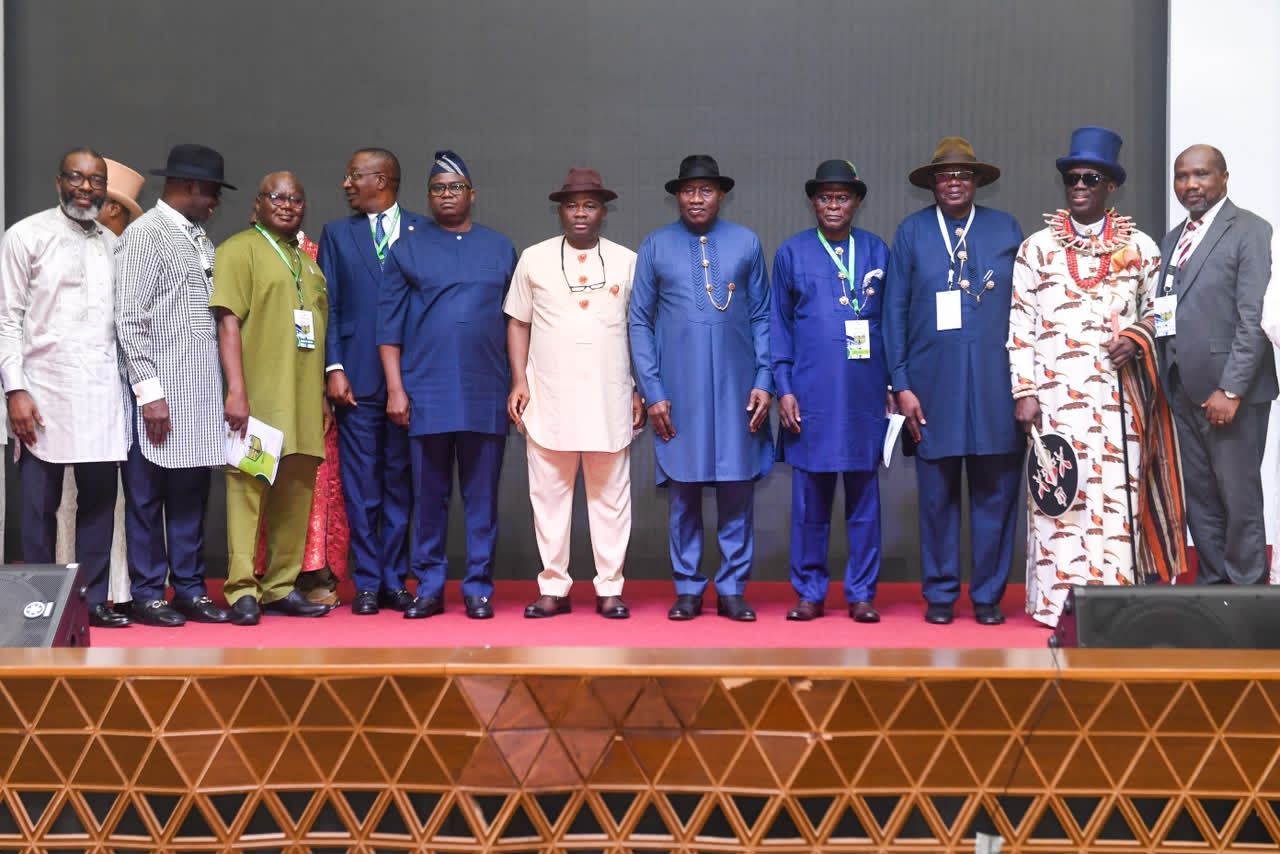
Jonathan hails NCDMB milestones, says China inspired Nigeria’s local content policy
Former President Goodluck Ebele Jonathan has applauded the remarkable achievements of the Nigerian Content Development and Monitoring Board (NCDMB), revealing that Nigeria’s local content policy was inspired by China’s success in developing its domestic oil and gas industry.
Jonathan made the disclosure on Monday while delivering the opening address at the SweetCrude Dialogue 2026, held at the Nigerian Content Tower (NCT) in Yenagoa, Bayelsa State. The event, themed “Through the Python’s Eye: 70 Years of Oil and Gas Production,” brought together government officials, industry leaders, academics and stakeholders to assess the evolution of Nigeria’s petroleum industry over the past seven decades.
The former President expressed satisfaction with the enactment of the Nigerian Oil and Gas Industry Content Development (NOGICD) Act, 2010, describing it as one of the landmark decisions of his administration. He said the legislation had transformed Nigeria’s oil and gas industry through the establishment of the NCDMB, which has evolved into a key driver of business growth and indigenous capacity development.
Jonathan recalled that he signed the NOGICD Bill into law in April 2010 with great enthusiasm, noting that the idea was conceived during a visit to China while serving as Deputy Governor of Bayelsa State between December 2005 and May 2007.
According to him, he was impressed that virtually every component used in China’s oil industry was sourced locally, a development that underscored the country’s commitment to self-reliance and industrialisation.
He explained that China became a major global player in the oil and gas sector following the discovery of crude oil at the Daqing Oilfield in 1959, just three years after crude oil was discovered in Oloibiri, present-day Bayelsa State.
Jonathan said the experience left him questioning why Nigeria, despite discovering oil almost at the same time, remained heavily dependent on foreign expertise, technology, equipment and production inputs.
He lamented the huge economic losses caused by the country’s over-reliance on imported services and technologies and said this informed the resolve to establish a legal framework that would promote indigenous participation in the oil and gas value chain.
The former President commended the NCDMB for its sustained achievements in implementing the Act and also praised the organisers of the SweetCrude Dialogue, De Mangrove Conversations, led by Mr. Biobele Da-Wariboko, for creating a platform to discuss the future of Nigeria’s oil and gas industry.
He stressed that conversations involving stakeholders from different sectors were essential for addressing challenges facing host communities, adding that the Petroleum Industry Act (PIA), 2020, had also made significant contributions to the sector.
Representing the Executive Secretary of NCDMB, Engr. Felix Omatsola Ogbe, the Board’s Director of Monitoring and Evaluation, Barrister Esueme Dan Kikile, described the dialogue as an important opportunity to review the industry’s history, assess current achievements and define future priorities.
He credited Jonathan for his decisive leadership in facilitating the establishment of both the NOGICD Act and the NCDMB, noting that local content participation in Nigeria’s oil and gas industry had risen dramatically from less than five per cent in 2010 to 61 per cent in 2026.
According to him, the Board has consistently pursued its mandate of supervising, coordinating and monitoring compliance with local content requirements while ensuring that a significant share of industry expenditure is retained within the Nigerian economy.
Kikile said the Board’s Human Capacity Development Initiative Guidelines have compelled operators to dedicate resources to training Nigerian engineers, geologists, technicians and seafarers on every major industry project.
He added that the Board’s flagship “60-40” Graduate Training Model, global technical certification programmes and vocational training initiatives for host communities had created a continuous pipeline of industry-ready professionals.
Highlighting key projects undertaken by the NCDMB, he listed the 17-storey Nigerian Content Tower in Yenagoa, the Oloibiri Museum and Research Centre, the Nigerian Oil and Gas Parks at Emeyal I in Bayelsa State and Odukpani in Cross River State, gas processing infrastructure at the Gbarain hub, the Polaku Gas Project footprint, the Brass Shipyard, the Nigeria Liquefied Natural Gas (NLNG) Fertiliser Project alignment, and the Back-to-the-Creek Initiative aimed at taking development directly to oil-producing communities.
He said the Board’s investments were repositioning Bayelsa State from merely being the birthplace of Nigeria’s oil industry to becoming a centre for industrialisation, technological advancement and value retention.
Delivering a goodwill message, Bayelsa State Governor Senator Douye Diri, represented by Deputy Governor Dr. Peter Akpe, said there was no better venue to reflect on 70 years of Nigeria’s oil and gas industry than Bayelsa, where crude oil was first discovered.
He commended De Mangrove Conversations for preserving the history and contributions of the Niger Delta to Nigeria’s economic development.
Similarly, Delta State Governor Sheriff Oborevwori, represented by his Chief of Staff, Prince Johnson Erijo, urged stakeholders to renew their commitment to the welfare of host communities while assessing the industry’s progress.
Also speaking, the Managing Director of the Niger Delta Development Commission (NDDC), represented by his Chief of Staff, Mr. Julius Oworibo, said the dialogue provided an opportunity to reflect on the journey of the oil-producing region, celebrate achievements and identify pathways for greater development.
In his keynote address, Professor Ibibia Lucky Worika of the Centre for Advanced Law Research, Rivers State University, observed that oil had shaped Nigeria’s economy, politics, foreign relations and development over the past 70 years while also fuelling conflicts and environmental degradation.
He stressed that communities in the Niger Delta had borne the consequences of decades of oil exploration and production, insisting that environmental justice must remain a constitutional, moral and developmental priority.
Earlier, the Convener of De Mangrove Conversations, Mr. Biobele Da-Wariboko, said the initiative was established to ensure that the immense contributions of the Niger Delta to Nigeria’s development are not forgotten amid the country’s evolving political landscape.
