

Global experts diagnose Nigeria’s power crisis as ‘System Failure,’ not Energy Shortage
Global attention turned sharply to Nigeria’s troubled electricity sector on Monday as leading energy experts declared that the country’s persistent power crisis stems not from a lack of resources, but from deep-rooted systemic failures.
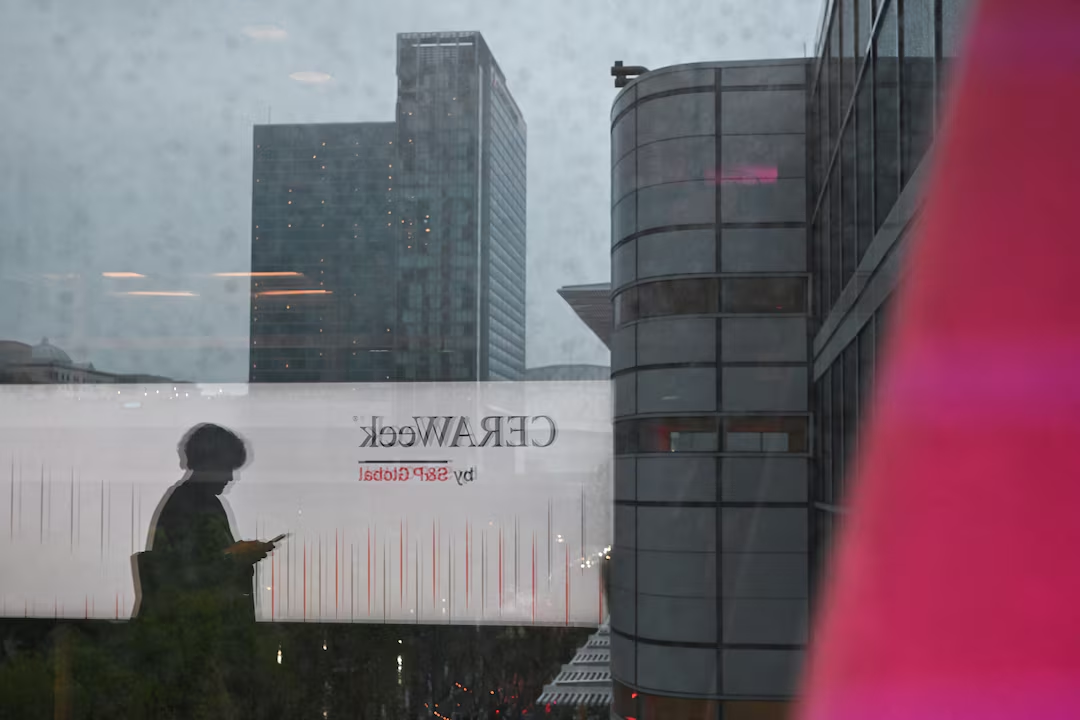
The verdict emerged at the high-level CERAWeek held in Houston, where industry leaders gathered to examine “Continental Opportunity: Scaling Energy Access in Africa’s Resource-Rich Economies.”
Far from being resource-poor, Nigeria sits atop vast energy reserves. Yet, according to Silvia Macri, Associate Director and Africa and Middle East Power and Renewables Lead at S&P Global Energy, the country’s electricity woes are rooted in a breakdown across the entire energy value chain.
“Nigeria’s challenge is not about the volume of resources it possesses,” Macri said. “It is about whether the system—from production to delivery—is functioning efficiently.”
Despite holding over 200 trillion cubic feet of natural gas, Nigeria generates only about seven gigawatts of reliable electricity—grossly insufficient for its rapidly growing population. Macri pointed to critical gaps including limited gas pipeline infrastructure, weak transmission and distribution networks, and chronic underinvestment in generation capacity.
“These are not isolated problems,” she stressed. “They reflect a system that is not properly connected or coordinated.”
Other experts at the session reinforced the diagnosis, warning that fragmented planning and poor execution continue to undermine the sector’s performance.
Laura Sima, Director of Upstream Solutions at S&P Global Energy, highlighted the financial hurdles stalling progress. She noted that essential infrastructure such as pipelines and national grids often deliver low financial returns, discouraging private sector participation.
“Infrastructure is critical, but not always profitable. That raises a fundamental question about who should bear the cost,” she said, pointing to government intervention as indispensable.
Sima also flagged persistent payment inconsistencies to gas suppliers, which have eroded investor confidence and slowed further development.
Adding another layer of complexity, Justin Cochrane, Director of Upstream Solutions and Technical Research for Africa at S&P Global Commodity Insights, warned that currency volatility remains a major deterrent to foreign investment.
“You invest in dollars and get repaid in a weakening naira—that’s a serious risk,” Cochrane said, underscoring the macroeconomic instability facing investors.
While the outlook appears challenging, experts pointed to renewable energy as a viable short-term solution, particularly for off-grid and decentralized systems. However, they cautioned that gas-fired power remains indispensable for grid stability and long-term energy security.
Beyond Nigeria, the session highlighted Africa’s growing appeal as a destination for global energy investment, driven by rising demand and shifting geopolitical dynamics. Yet, panelists warned that without structural reforms, improved governance, and sustained infrastructure investment, resource-rich nations may continue to fall short of their potential.
The consensus was unequivocal: Nigeria’s electricity crisis is not a consequence of scarcity, but a failure to build, connect, and manage the systems required to deliver power effectively.
For Africa’s largest economy, the path forward will demand coordinated reforms, targeted investments, and a renewed commitment to fixing the fundamentals of its energy architecture.
