

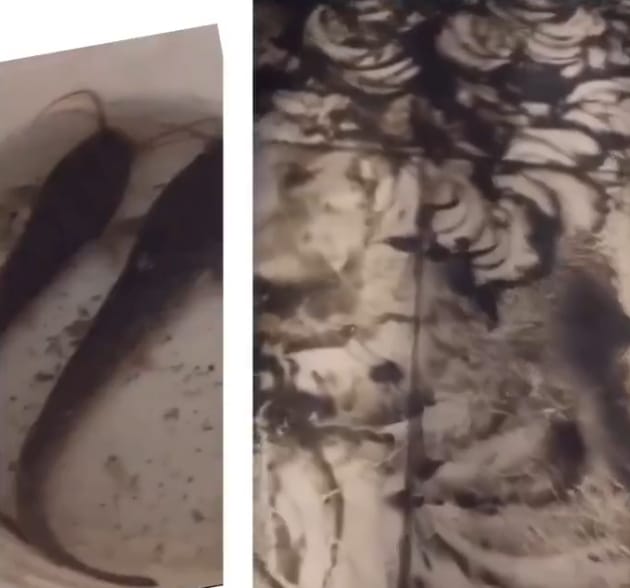
Lekki inundation: Residents trap catfish in bedrooms as Lagos-Calabar coastal highway triggers unprecedented flooding
In what has rapidly transformed from an environmental inconvenience into a harrowing nightmare, residents of the upscale Lekki corridor in Lagos State are confronting an unprecedented ecological crisis.
High-brow estates, where apartments command rents upwards of ₦500,000 monthly, have been turned into submerged waterways, leaving affluent homeowners and tenants literally fishing for survival inside their living rooms.
The dramatic escalation in flooding has seen aquatic life—specifically live catfish—swimming through bedrooms, kitchens, and sitting rooms across several communities in the Lekki-Epe expressway axis. Affected residents strongly attribute the catastrophic surge to the ongoing construction of the flagship Lagos-Calabar Coastal Highway, supervised by the Minister of Works, David Umahi.
According to community leaders and affected urban dwellers, the current crisis is the direct legacy of the engineering approach adopted for the massive infrastructure project. The Lagos-Calabar Coastal Road is built upon a sensitive coastal marshland and natural seashore that historically acted as a crucial wetland buffer for ocean surges and seasonal runoff.
To construct the highway, vast stretches of this natural marine ecosystem were sand-filled. However, residents allege that the project was executed without robust, large-scale drainage channels capable of diverting displaced water bodies away from existing residential layouts. Consequently, millions of gallons of water, deprived of their natural seaward flow pathways, have been forcefully redirected inland—straight into the living spaces of adjacent neighborhoods.
”We are paying as much as ₦500,000 per month just to live in luxury, but today we are sharing our bedrooms with catfish,” lamented a distressed resident of an affected estate in Lekki Phase 1. “When they sand-filled the shoreline for the coastal road, they sealed off the primary outlets where rainwater and tidal overflows used to discharge. Now, the water has nowhere else to go but our living rooms.”
The presence of freshwater and brackish aquatic species inside residential quarters underscores the severity of the tidal displacement, signaling that natural coastal habitats have been entirely disrupted.
The Lagos-Calabar Coastal Highway is a major 700-kilometer infrastructure project designed to connect Lagos State directly to the South-South region of Nigeria, terminating in Calabar, Cross River State. Spearheaded under the administration of President Bola Ahmed Tinubu and executed through the Federal Ministry of Works led by Minister David Umahi, the multi-trillion naira project was conceived to boost maritime trade, enhance tourism, and streamline interstate logistics along Nigeria’s Atlantic coastline.
Advertisement
However, since its inception, the project has been mired in intense public debate, environmental scrutiny, and political friction:
Environmentalists and urban planning experts continuously warned that massive sand-filling operations along the sensitive Atlantic oceanfront without rigorous Environmental Impact Assessments (EIA) would destabilize the delicate hydrological balance of the Lekki peninsula.
Right-of-Way Demolitions: The corridor witnessed high-profile property demolitions, commercial dislocations, and legal disputes regarding compensation for affected landowners along the coastline.
Infrastructure Strain: Critics have persistently argued that prioritizing a mega-coastal highway without first integrating comprehensive regional flood control channels exposes surrounding residential zones—already vulnerable to sea-level rise—to extreme inundation risks.
Growing Calls for Urgent Federal Intervention
As heavy rainfall continues across the coastal state, fear is rising among Lekki inhabitants over potential waterborne disease outbreaks, structural damage to expensive real estate assets, and prolonged displacement.
Community associations across the Lekki axis are now urgently calling on the Federal Ministry of Works, the Lagos State Ministry of the Environment and Water Resources, and primary contractors to immediately suspend non-essential sand-filling operations and construct critical primary drainage channels, culverts, and ocean outlets to alleviate the residential flood crisis before permanent ecological damage occurs.
Severe flooding in Lekki, Lagos, has forced ocean water and catfish into residential homes due to massive sand-filling along marshy seashores for the Lagos-Calabar Coastal Highway project.
The absence of adequate arterial drainage channels along the new highway corridor has redirected displaced ocean surges inland into high-density estates.
