

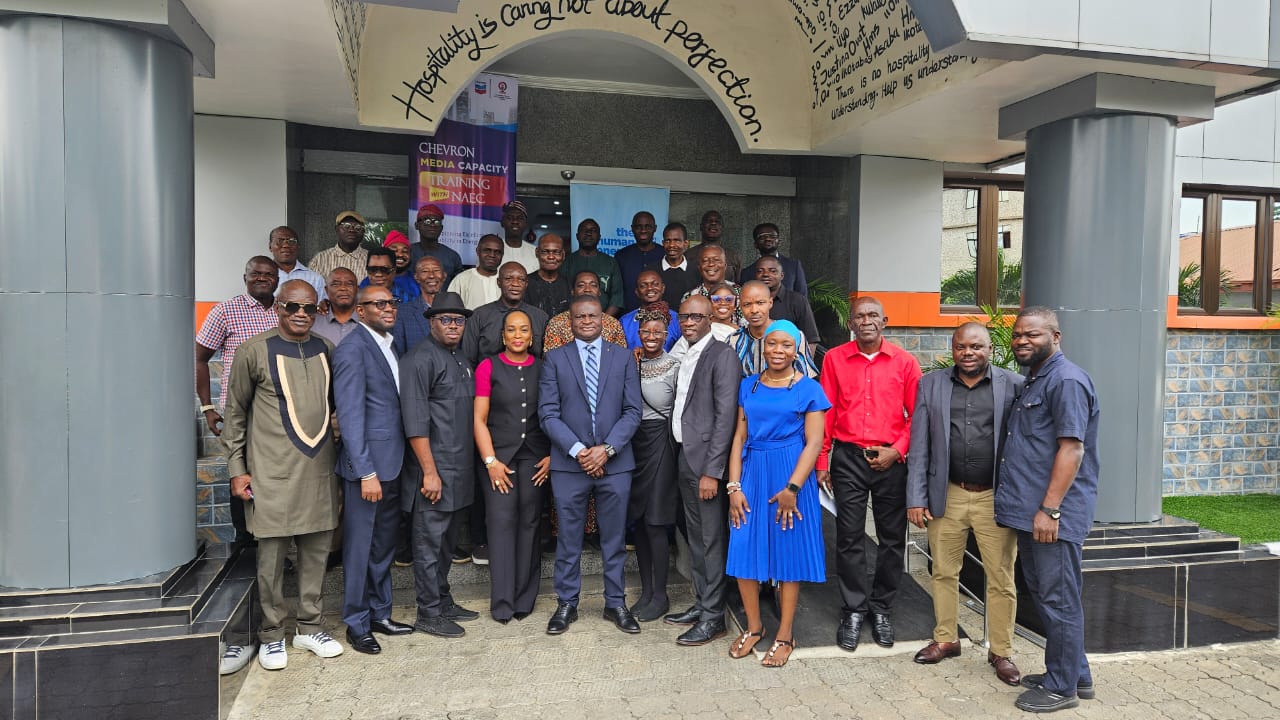
Chevron/NAEC workshop: Experts urge journalists to embrace data, innovation, continuous learning
Energy correspondents in Nigeria have been urged to deepen their expertise through continuous learning, embrace investigative and data-driven reporting, and leverage innovation while avoiding overreliance on artificial intelligence (AI) to produce credible and impactful journalism.
The recommendations were made by speakers at the Chevron Media Capacity Building Training for members of the Association of Energy Correspondents of Nigeria (NAEC), held on Monday in Lagos.
The General Manager, Corporate Affairs, Chevron Nigeria Limited, Mr. Olusoga Oduselu, represented by the company’s Manager/Chief Communications Officer, Dr. Victor Anyaegbudike, underscored the importance of capacity development in strengthening journalism, particularly in the oil and gas sector.
Oduselu reaffirmed Chevron’s commitment to supporting NAEC’s pursuit of media excellence, describing energy correspondents as critical partners in promoting transparency, accountability, and informed public discourse.
“We deeply appreciate the role of the media as a trusted source of information and an important partner in shaping conversations around the energy sector,” he said.
Anyaegbudike highlighted Chevron’s long-standing investment in journalists’ training through initiatives such as the Advanced Writing and Reporting Skills (AWARES) Programme. According to him, more than 120 journalists have benefited from the programme since 2014, while over 310 journalists have received training across Nigeria in recent years.
He also reiterated Chevron’s commitment to Nigeria’s development through local content promotion, community engagement initiatives, and sustainable energy investments, including gas development projects and regional infrastructure such as the West African Gas Pipeline.
Delivering a presentation titled Nigeria’s Regulatory Environment, Global Energy Transition Trends and the Media’s Role in Policy Interpretation, Principal Consultant and Trainer at CETTLE Consulting Nigeria Ltd., Dr. Charles Ebereonwu, stressed the critical role of the media in explaining complex energy policies amid the global energy transition and market volatility.
He noted that while countries are pursuing cleaner energy sources, energy security remains a top priority, with fossil fuels continuing to play a significant role, particularly in developing economies such as Nigeria.
According to him, global geopolitical tensions continue to influence oil prices and supply, while Nigeria remains vulnerable to market fluctuations due to domestic challenges, including infrastructure deficits and supply gaps.
He added that Nigeria’s Energy Transition Plan targets universal access to energy by 2030 and net-zero emissions by 2060.
Ebereonwu urged journalists to move beyond routine reporting by embracing investigative, data-driven and policy-focused journalism.
“The media is the fourth estate of the realm and must act in the best interest of society—independent, informed and courageous,” he said.
He also identified major challenges confronting journalism, including inadequate in-depth reporting, political and ethnic bias, poor remuneration that undermines editorial independence, and a weak fact-checking culture.
In his presentation, Senior Lecturer in the Department of Communication and Media Studies at Lagos State University (LASU), Dr. Ganiu Okunnu, examined the growing influence of artificial intelligence in journalism, cautioning against excessive dependence on AI tools.
He emphasised that AI should complement, rather than replace, journalistic thinking, noting that the quality of AI-generated output depends largely on the quality of prompts provided by users.
“AI does not replace intelligence; it reflects the intelligence of the user,” he said, urging journalists to remain analytical, original and thorough in applying AI to their work.
Also speaking, award-winning journalist and editor, Odinaka Anudu, called on energy correspondents to move beyond routine reporting by embracing investigative and data-driven journalism.
He described data as the foundation of serious investigative reporting, stressing that business journalists must look beyond press releases to uncover hidden realities within the economy.
According to Anudu, journalists should be able to interpret corporate financial statements and annual reports to produce insightful stories.
“Data reporting is essential for understanding how systems truly work, and strong investigative stories often rely on primary data generated by journalists themselves,” he said.
“If data is not mined, you will not understand the essence of what is happening.”
He criticised the culture of “copy-and-paste journalism,” warning that it erodes credibility and diminishes the relevance of the media.
Anudu encouraged journalists to conduct multiple interviews and undertake field investigations to gather sufficient evidence for compelling reports.
“Ask critical questions such as ‘how many?’ and ‘how much?’ Develop original enterprise stories that provide fresh insights because readers are interested in what is new,” he said.
“No one takes journalists who only do PR stories seriously. Respect comes from depth, rigour and originality.”
