

Lagos, June 2026 (TBL Africa) Stakeholders in the transport and supply chain sector say poor logistics infrastructure is undermining economic growth, increasing costs of doing business, fuelling inflation and weakening competitiveness.
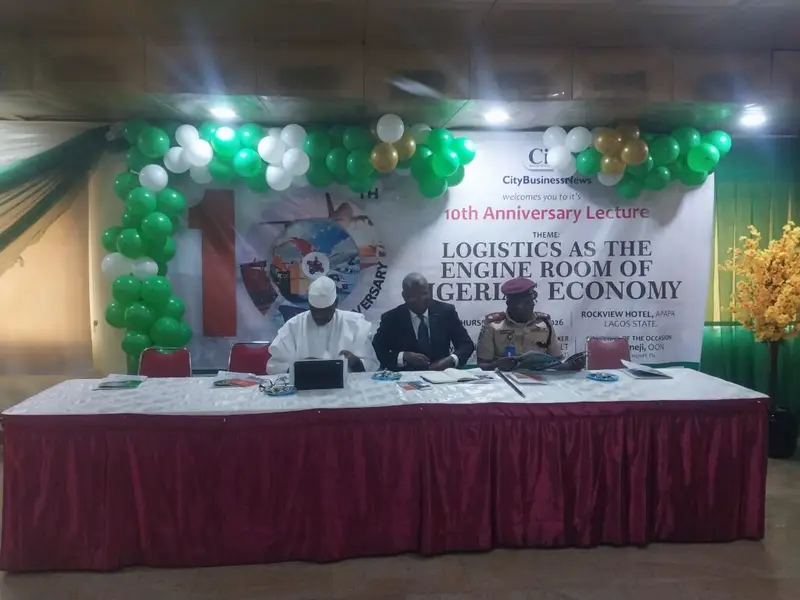
The stakeholders spoke at the 10th Anniversary Lecture of City Business News held in Lagos, where they reviewed the state of the logistics and transport ecosystem.
The event has as its theme: “Logistics as the Engine Room of Nigeria’s Economy”.
President, Chartered Institute of Logistics and Transport (CILT), Dr Boboye Oyeyemi, while delivering the keynote address, said logistics remained central to all economic activities and national productivity.
“Everything you want to do needs planning, and your plan is the logistics,” Oyeyemi said.
He explained that efficient logistics systems support manufacturing, agriculture, trade and the movement of goods and people across the country.
According to him, the freight and logistics sector has grown into a multi-billion-dollar industry with significant potential for expansion if properly harnessed.
Oyeyemi, a former Corps Marshal of the Federal Road Safety Corps (FRSC), said the country remained heavily dependent on road transport, accounting for about 90 per cent of freight and passenger movement.
He, however, identified poor infrastructure, high operating costs and supply chain inefficiencies as major challenges limiting the sector’s contribution to economic growth.
The logistics expert warned that inefficiencies in supply chains increase the cost of doing business and ultimately push up consumer prices.
“A breakdown in supply chain velocity does not stay in the warehouse. It paralyses retail and triggers inflation,” he said.
Oyeyemi also linked weak logistics systems to food losses, supply disruptions and reduced competitiveness across key sectors of the economy.
The Publisher of City Business News, Mr Moses Ebosele, said logistics had evolved from a support function into a strategic driver of economic growth and competitiveness.
He noted that the efficient movement of goods, services and people remained critical to industrialisation, trade expansion and consumer welfare.
Ebosele called on governments at all levels to implement policies that support logistics operators and strengthen the transport sector.
He identified improved port operations, rail connectivity, road infrastructure and inland waterways as key to building a more efficient logistics ecosystem.
Chairman of the occasion and Founder of ABC Transport Plc, Mr Frank Nneji, said logistics play a vital role in driving economic activity across sectors.
“It moves the economy,” Nneji said.
He urged increased investment in road infrastructure, noting that road transport remains the dominant mode of movement for most Nigerians.
Also, National Chairperson of Women in Logistics and Transport (WiLAT) Nigeria, Ms Khadijat Sheidu-Shabi, said efficient logistics systems are essential for sustainable economic growth.
She noted that no economy could thrive without the seamless movement of people, goods, services and information across value chains.
Sheidu-Shabi said women were playing an increasing role in the sector, occupying leadership positions across maritime, aviation, freight forwarding, supply chain management and logistics technology.
According to her, greater inclusion of women will strengthen the sector’s capacity to support national development.
The anniversary lecture attracted stakeholders from the Nigerian Ports Authority (NPA), Nigeria Customs Service (NCS), Nigerian Maritime Administration and Safety Agency (NIMASA), Nigerian Shippers’ Council (NSC) and other agencies.
The event marked a decade of City Business News’ coverage of business, maritime, transport and logistics issues, with stakeholders reaffirming the sector’s importance to Nigeria’s economic future.
