

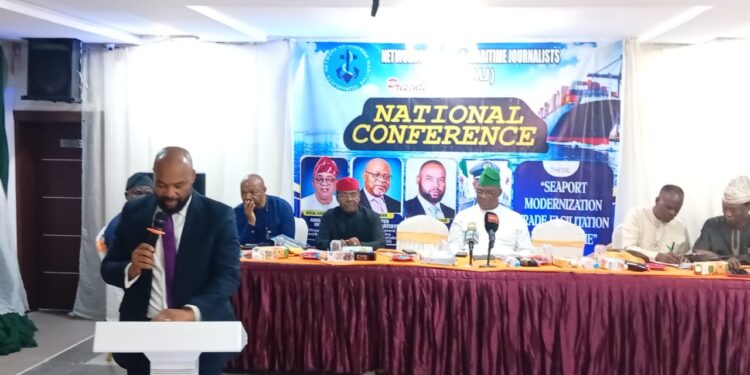
Nigerian Seaports Unprepared to Carry $1 Trillion Economy by 2030’
Renownedmaritime lawyer and Senior Advocate of Nigeria (SAN), Dr. Emeka Akabogu, has declared that Nigeria’s seaports, in their current operational state, lack the capacity to support the Federal Government’s ambition of achieving a $1 trillion economy by 2030.
Akabogu spoke at the National Unity Conference of Network of Nigerian Maritime Journalists (NNMJ) held in Lagos today. NNMJ is the umbrella body of all the maritime Journalists associations.
Delivering a presentation titled “Can Nigeria’s Seaports Carry a One Trillion Dollar Economy by 2030”, Akabogu laid out a blunt assessment of the nation’s maritime infrastructure against macroeconomic realities.
“I pose the question, which is: do our seaports, as constituted today, have the capacity to carry a $1 trillion economy? Now, my very honest answer to that question is No. As presently constituted, our seaports are unable to carry that capacity” Akabogu stated.
Citing International Monetary Fund (IMF) data, Akabogu noted that Nigeria’s Gross Domestic Product (GDP) stood at $290 billion in 2025, with an estimated projection of $387 billion for 2026. He said bridging the gap to $1 trillion within four years requires expanding the economy to nearly three times its current size, assuming relative currency stability.
However, he warned that current growth trajectories fall far short of what is required.
“IMF projects that we may be able to expand up to 9% by 2030. So if we go by IMF calculations, chances are that by 2030 we’ll be achieving an annual blueprint of 9%, which is still significant. In fact, it is three times lower than the anticipated or desired 26.8% that is required to hit $1 trillion in 2030,” he explained.
To hit the $1 trillion mark, Nigeria’s economy must expand at an average rate of roughly 27% per year in US dollar terms nearly tripling the IMF’s baseline projection, he stated.
According to Akabogu, achieving this scale of economic expansion demands a radical overhaul of Nigeria’s trade facilitation, port modernisation, and revenue generation frameworks.
“For us to achieve the target, we need a port system that would be able to aid it. Which means we need to have significant and seamless import and export improvements in the next four years. We need to triple or almost triple what we are spending and what we are earning today,” he said.
Benchmarking Nigeria against established $1 trillion-plus economies including India, Indonesia, Brazil, Turkey, Mexico, and Saudi Arabia, Akabogu pointed to stark deficits in container throughput and vessel traffic.
While Nigerian Ports Authority (NPA) statistics show encouraging recent momentum with container traffic rising from an average of 1.3 million Twenty-foot Equivalent Units (TEUs) over the decade preceding 2023 to 1.5–1.6 million TEUs in 2023, 1.75 million in 2024, and 2.1 million in 2025, the pace remains insufficient.
“If we continue at that pace, 2030 will see us achieving about 3.6 million containers per annum. Unfortunately, 3.6 million containers per annum is significantly lower than the targets which we’ve set,” Akabogu noted.
On ship ownership, he said Nigeria had about 307 Nigerian-owned ships in 2025. However, under the country’s present fleet growth pattern, the number may only increase to approximately 348 by 2030.
This means that even by 2030, Nigeria could still be short of about 572 ships against the estimated 920 vessels required to support a $1 trillion economy.
The presentation also showed that Nigeria’s flag fleet currently has a capacity of about 7.12 million deadweight tonnes (DWT), compared with an estimated requirement of 21.4 million DWT.
The figures raise questions about how Nigeria intends to move the huge volume of cargo that would accompany a significantly expanded economy, and whether local shipowners would be positioned to benefit from the growth in international trade.
Akabogu warned that expanding port infrastructure without building indigenous shipping capacity would leave Nigeria heavily dependent on foreign shipowners to move its imports and exports.
He also identified vessel traffic shortfalls, saying based on the current trajectory, Nigerian ports are projected to record approximately 5,340 ship calls annually by 2030.
“However, what we desire and what will anchor a $1 trillion economy in 2030 is not going to be 5,340 ship calls, which is what we’ll achieve at the current pace. Rather, it’s going to be between 10,800 and 13,300 ship calls,” he stated, stressing that bridging these operational gaps is non-negotiable if the maritime sector is to anchor Nigeria’s economic ambitions.
Concluding, Akabogu said: “Where our present pace will take us is strictly a matter of arithmetic and data, so we need to decide where we want to go. What is feasible must now be measured against what is desirable, and the distance between them is not a problem to be lamented, but a task for all of us to get done. Modernisation will not stand alone; it needs the naira to hold, it needs dollars to be earned from exports, it needs ships to carry the cargo, and it needs data that can move water. Every challenge identified is a clear pathway, and every opportunity leads us to work and that work starts here today.”
