

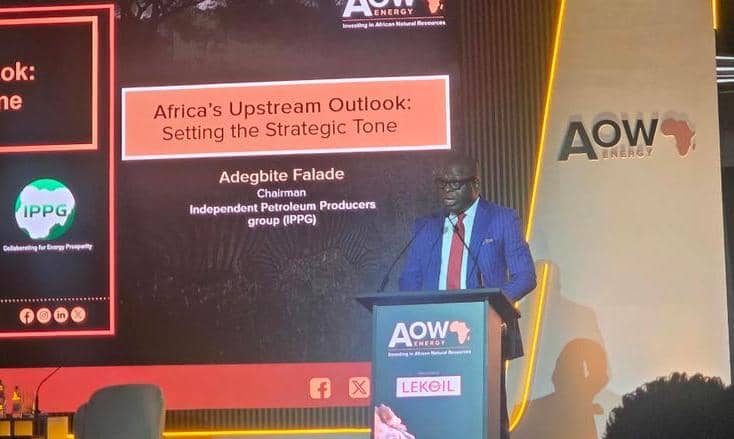
Africa’s $200bn energy gap beckons global investors — Falade
**** ldentifies gas infrastructure as a major investment frontier
Africa’s widening energy investment gap represents one of the continent’s biggest opportunities for global investors, with more than $200 billion required annually in energy investment by 2030, according to the Chairman of the Independent Petroleum Producers Group (IPPG), Adegbite Falade.
Falade, who spoke on “Africa’s Upstream Outlook: Setting the Strategic Tone” at the opening ceremony of AOW: Energy 2026 in Accra, Ghana, said Africa’s vast oil and gas resources, rising domestic energy demand and growing pool of indigenous operators offered investors a compelling opportunity to participate in the continent’s next phase of industrialisation.
Themed “Investing in African Natural Resources,” AOW: Energy 2026 focuses on accelerating exploration, unlocking upstream partnerships and aligning policy, infrastructure and markets to support sustainable investment.
Falade, however, warned that the opportunity could be lost unless governments, investors and industry players act urgently to close Africa’s financing and infrastructure deficits.
According to him, Africa holds more than 125 billion barrels of proven crude oil reserves and over 620 trillion cubic feet of proven natural gas reserves, representing about nine per cent and eight per cent of global oil and gas reserves respectively.
Yet, the continent attracts only about six per cent of global exploration spending and upstream capital, highlighting what Falade described as a significant gap between Africa’s resource endowment and the capital deployed to develop it.
Africa’s energy paradox
Falade said Africa’s paradox is that it remains both the world’s most energy-endowed and most energy-poor continent.
Africa produces approximately eight million barrels of crude oil daily but refines barely half of that volume, leaving the continent spending more than $60 billion annually on refined petroleum product imports.
Similarly, while Africa produced about 262 billion cubic metres of gas in 2025, domestic consumption stood at roughly 185 billion cubic metres, meaning a significant portion of its gas production is exported rather than deployed to address domestic energy shortages.
The consequence, he said, is a massive energy-access deficit, with nearly 600 million Africans lacking access to electricity.
For global investors, Falade argued, these figures point not only to Africa’s challenges but also to a sizeable pipeline of opportunities spanning upstream exploration, gas processing, pipelines, power generation, refining, petrochemicals and renewable energy.
“Reserves without pipelines are simply stranded molecules benefiting no one,” he said, stressing that upstream investment must be matched by investment in midstream infrastructure.
Indigenous operators emerging as key investment partners
Falade positioned Nigeria’s indigenous oil and gas companies as evidence that Africa’s energy resources can increasingly be developed by local operators working alongside international capital, technology and expertise.
He said Nigerian indigenous companies, which accounted for less than three per cent of national production just over three decades ago, now contribute more than half of the country’s crude oil and gas output following the divestment of several onshore and shallow-water assets by international oil companies.
According to him, about 200,000 barrels of oil per day have been added to Nigeria’s national production by just three indigenous operators over the past year.
Falade said the transition demonstrated that indigenous companies could revive mature and previously underperforming assets through technical competence, capital deployment and faster decision-making.
For international investors, he said, the changing ownership structure should be viewed as an opportunity for new partnerships rather than a retreat from Africa.
«“The divestment era is not an exit. It is an invitation to a new kind of partnership — technology, capital and capability alongside local ownership and local urgency.”»
Africa Energy Bank: Bridging the financing gap
Falade identified the Africa Energy Bank (AEB) as a major component of the IPPG’s investment proposition. The bank was established through a partnership between the African Petroleum Producers Organisation and Afreximbank.
He said the Abuja-headquartered bank has an initial capital base of $5 billion, with an ambition to mobilise up to $10 billion in its first phase and grow towards $15 billion by 2030.
He described the institution as a potentially critical vehicle for bridging the upstream and midstream financing gap created by the retreat of some traditional international financiers from African oil and gas projects.
However, he stressed that the bank’s success would depend on African producers developing commercially viable and bankable projects capable of attracting capital.
Gas infrastructure: a major investment frontier
Falade identified gas infrastructure as another major investment frontier, arguing that Africa’s vast gas reserves cannot be fully monetised without significant investment in pipelines, processing and power infrastructure.
Although natural gas already generates around 40 per cent of Africa’s electricity, he said the continent’s pipeline network remains inadequate to unlock the full economic value of its gas resources.
Africa has less than 50,000 kilometres of gas pipeline infrastructure, compared with more than 200,000 kilometres of interconnected oil and gas trunk pipelines in Europe, according to his keynote.
Falade therefore called for greater investment in gas pipelines, processing facilities, power grids and export infrastructure to transform Africa’s gas reserves into productive economic assets.
One African market for energy investors
Falade also urged investors to look beyond individual African markets and take advantage of deeper regional integration under the African Continental Free Trade Area (AfCFTA).
He cited the West African Gas Pipeline, which has transported Nigerian gas to Benin, Togo and Ghana for 15 years, as evidence that cross-border energy infrastructure can work on the continent.
He proposed a dedicated AfCFTA Energy Services Protocol to facilitate intra-African hydrocarbon trade, cross-border pipelines and infrastructure, as well as a Pan-African Technical Exchange Programme to accelerate the movement of skills and expertise across producing countries.
For investors, he said, deeper integration could create larger regional markets for gas-to-power, refining, petrochemicals and energy services, while reducing the constraints imposed by fragmented national markets.
Oil, gas and renewables must work together
While making a strong case for continued investment in oil and gas, Falade rejected the notion that Africa must choose between hydrocarbons and renewable energy.
He said Africa attracted only about two per cent of global clean-energy investment last year, despite possessing some of the world’s richest renewable resources.
Africa’s installed renewable capacity has grown from about 33GW in 2014 to 82GW in 2025, but Falade said the continent was still exploiting only a fraction of its solar, hydro, geothermal and wind potential.
His message to investors was therefore one of diversification: gas and renewables should be developed together to close Africa’s energy-access gap and support industrialisation.
Falade warned that the growing retreat of international capital from African oil and gas projects, driven partly by global decarbonisation policies, had already left more than 150 projects stalled across the continent, according to industry estimates.
He argued that Africa’s responsibility for less than three per cent of global greenhouse gas emissions, alongside its substantial oil, gas and renewable resources, warranted an energy-development strategy tailored to the continent’s needs.
«“Africa’s energy must first power Africa,”»
he said, advocating greater investment in gas-to-power, gas-to-fertiliser, gas-to-industry, refining, petrochemicals, LPG for clean cooking and reliable power for manufacturing.
A major investment proposition
For global investors, Falade’s message is clear: Africa’s energy challenge is also an investment opportunity.
The continent needs capital, technology, infrastructure and expertise at a scale that domestic resources alone cannot provide. At the same time, African indigenous operators are increasingly positioned to provide local ownership, market knowledge and operational capacity.
Falade called on governments to provide fiscal stability, faster permitting and contract sanctity, while urging financiers and insurers to assess African risk based on operational evidence rather than prevailing narratives.
He said the next phase of Africa’s energy development would require a new investment model built around international capital and technology working alongside increasingly capable African companies.
