

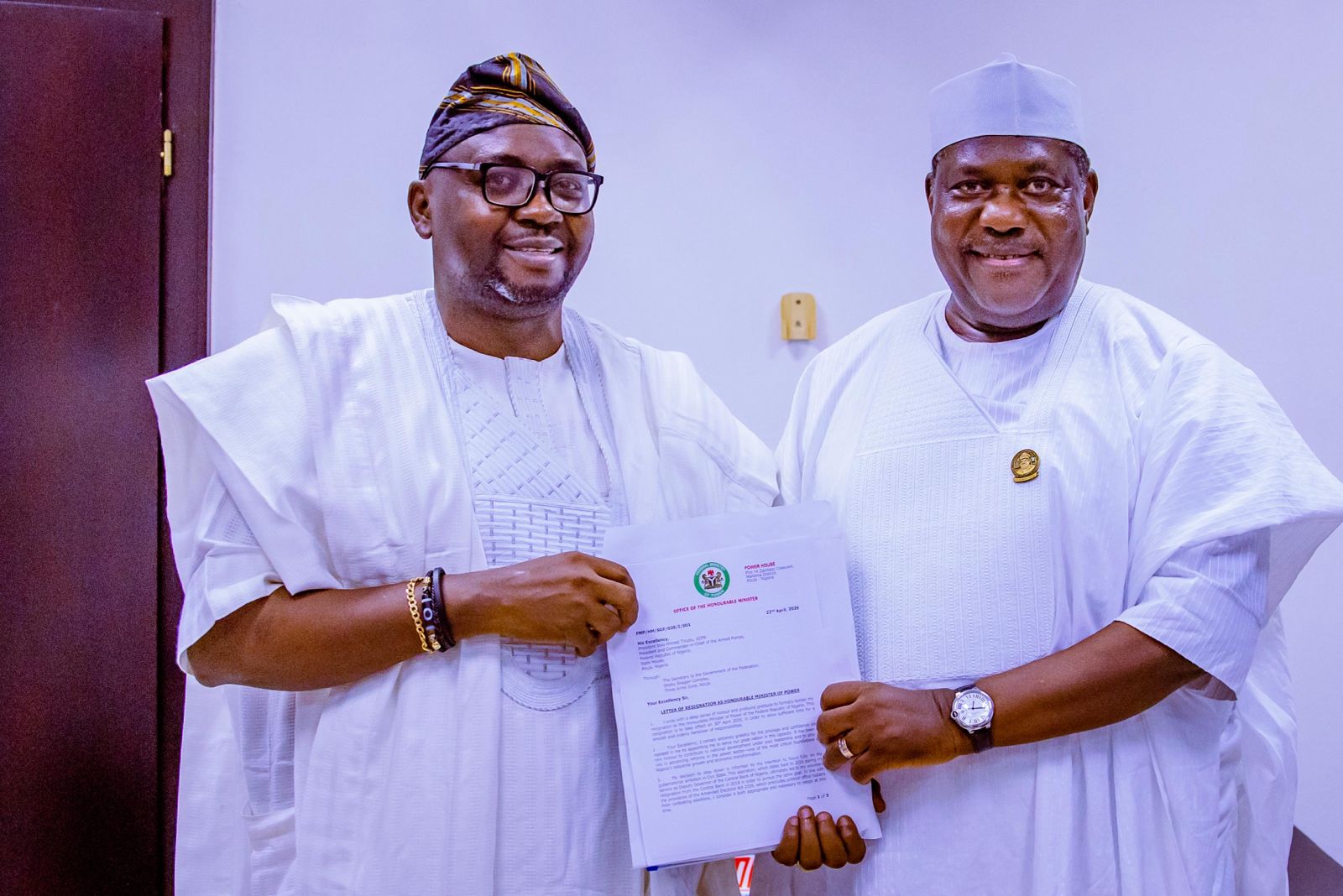
Adelabu resigns as Power Minister, proposes coordinating energy Minister for sector reforms

The Minister of Power, Chief Adebayo Adelabu, has formally submitted his resignation and proposed the creation of a Coordinating Minister for Energy to drive unified reforms across Nigeria’s power, gas, and allied sectors.
In a letter dated April 22, 2026, and addressed to President Bola Ahmed Tinubu, Adelabu stated that his resignation will take effect from April 30, 2026.
He explained that the decision would enable him to focus on his governorship ambition in Oyo State.
The Minister, however, stressed that consolidating the gains recorded in the power sector requires stronger coordination at the highest level, including the establishment of a central authority to harmonise policy direction and execution.
Confirming the development, the Special Adviser on Strategic Communications and Media Relations, Bolaji Tunji, said Adelabu expressed profound appreciation to the President for the opportunity to serve, describing his tenure as a privilege to contribute to national development.
Adelabu noted that his resignation aligns with the provisions of the Amended Electoral Act 2026, which restricts serving public office holders from contesting elections.
He also revealed that his gubernatorial ambition dates back to 2016, during his tenure as Deputy Governor of the Central Bank of Nigeria.
In his three-page letter, the Minister highlighted key achievements during his tenure, notably the implementation of the Electricity Act 2023, which decentralised the electricity market and enhanced the investment climate.
He disclosed that peak power generation exceeded 6,000 megawatts, driven by the integration of the Zungeru Hydropower Plant and the rehabilitation of major thermal power stations.
He further noted improvements in transmission capacity through grid upgrades under the Presidential Power Initiative, as well as progress in the distribution segment, including stronger regulatory oversight, improved revenue collection, and reductions in Aggregate Technical, Commercial and Collection (ATC&C) losses.
Efforts to close Nigeria’s metering gap, he added, gained traction through the Presidential Metering Initiative and the World Bank-supported Distribution Sector Recovery Programme (DISREP).
On the financial side, Adelabu said tariff reforms and a ₦4 trillion debt restructuring programme boosted market revenues from ₦1 trillion in 2023 to ₦2.3 trillion in 2025, restoring investor confidence and positioning the sector for long-term sustainability.
Despite these gains, he acknowledged ongoing challenges such as gas supply constraints, infrastructure vandalism, and the need for full commercialisation of the electricity value chain.
To sustain progress, the outgoing Minister recommended key measures, including the implementation of cost-reflective tariffs with targeted subsidies, recapitalisation of distribution companies, accelerated nationwide metering, continued investment in transmission infrastructure, and stronger regulatory enforcement.
Central to his recommendations is the creation of a Coordinating Minister for Energy to provide strategic oversight and ensure synergy across power, gas, water resources, and environmental sectors.
He noted that such coordination is critical for improving gas supply to thermal plants, optimising hydroelectric resources, and accelerating renewable energy deployment.
Tunji added that Adelabu remains committed to ensuring a smooth and seamless handover process, while reiterating his gratitude to the President for the confidence and support extended to him throughout his tenure.
